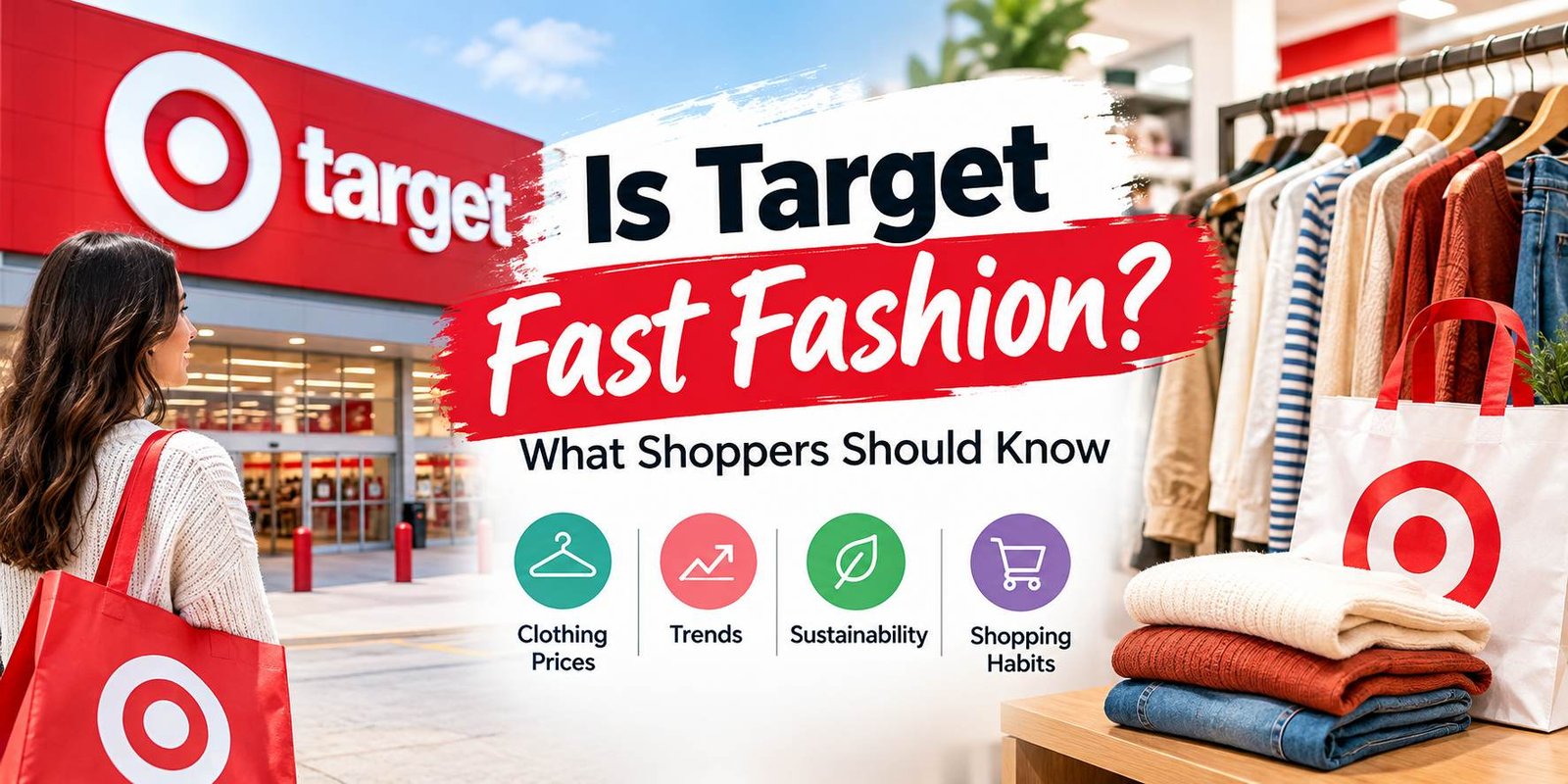
Is Target Fast Fashion? A Detailed Guide for Shoppers
When people think about fast fashion, they often picture brands that release new clothing quickly, follow social media trends, and keep prices low. This raises an important question for shoppers who buy clothes from major retailers: is Target fast fashion?
The short answer is Target is not a pure fast-fashion company, but parts of its apparel business use practices that overlap with fast fashion. Target sells clothing at accessible prices, offers trend-focused collections, and has been working to speed up the process of bringing new styles to stores. At the same time, Target also sells national brands and operates many of its own apparel labels, while publicly investing in circular design and sustainability programs. Target Corporation
So, calling Target simply a “fast-fashion brand” does not tell the whole story. A closer look at its business model, clothing collections, production approach, and sustainability efforts gives shoppers a more useful answer.
What Does Fast Fashion Mean?
Fast fashion generally refers to a clothing business model built around quick trend response, relatively low prices, frequent product changes, and high-volume consumption.
Traditional fashion collections may take much longer to develop. Fast-fashion companies try to shorten that process so shoppers can find styles that reflect current trends soon after those trends become popular.
Common characteristics of fast fashion include:
- Affordable clothing prices
- Frequent introduction of new styles
- Strong focus on current trends
- Rapid product development
- Large production volumes
- Shorter product cycles
- Encouragement of frequent purchases
However, there is no single official rule that determines whether a retailer is fast fashion. A company can share some of these characteristics without fitting perfectly into the traditional fast-fashion category.
That distinction is especially important when discussing a large retailer such as Target.
So, Is Target Fast Fashion?
Target is best described as a large mass-market retailer with some fast-fashion characteristics rather than a dedicated fast-fashion company.
Target’s business is much broader than clothing. Its stores and online business include apparel, beauty products, food, home furnishings, household essentials, electronics, and many other categories. In its 2025 annual report, Target reported that apparel and accessories represented about 15% of merchandise sales, showing that clothing is an important category but not the company’s entire business.
Target also sells a combination of national brands and its own exclusive or owned brands. Its apparel-related brands include names such as A New Day, Universal Thread, Goodfellow & Co., Future Collective, All in Motion, Cat & Jack, and Auden.
This makes Target different from a retailer whose entire business is centered on rapidly changing low-cost fashion.
Why Do Some People Consider Target Fast Fashion?
There are several reasons Target is sometimes included in discussions about fast fashion.
1. Target Offers Affordable Clothing
Price is one of the strongest similarities.
Target has built its retail identity around combining style, design, and value. Its annual report describes the company as offering fashionable merchandise and everyday essentials at discounted prices.
Affordable clothing makes fashion accessible to more shoppers. However, low prices alone do not automatically make a company fast fashion.
A retailer needs to be considered in the context of its entire production and merchandising model.
2. Target Responds to Fashion Trends
Another similarity is Target’s focus on trend-driven products.
Target says its merchandising strategy includes a trend-forward point of view. The company has also described efforts to move trend-inspired apparel from initial ideas to products more quickly.
This can look similar to fast fashion because consumers may see new styles appearing while a trend is still popular.
3. Target Has Its Own Fashion Brands
Target operates numerous owned brands rather than simply selling clothing made by unrelated companies.
For example, Universal Thread focuses heavily on denim and casual apparel, while A New Day offers women’s fashion and Goodfellow & Co. serves men’s clothing and accessories.
Having control over owned brands can allow a retailer to influence product design, merchandising, sourcing, and launch schedules.
That flexibility can create some overlap with the fast-fashion model.
Target Is Speeding Up Trend-Based Fashion
One of the most important developments is Target’s stated effort to make its apparel process faster.
In a 2025 article about its fashion strategy, Target described using faster and more flexible production models to bring trend-focused products to customers more quickly. The company gave an example involving seasonal trends and said its teams were able to accelerate development timelines through closer collaboration with vendors and material suppliers.
This is a meaningful reason why people may associate Target with fast fashion.
The company does not need to operate exactly like a specialist fast-fashion retailer for some of its processes to resemble fast-fashion practices.
Target Is More Than a Fast-Fashion Retailer
There is another side to the question.
Target is a huge multi-category retailer. Clothing represents only part of its overall merchandise business. Its product mix includes food, beauty, home products, household essentials, and hardlines in addition to apparel.
Target also sells many established national brands alongside its owned labels.
Therefore, describing the entire company as fast fashion would be too broad.
A better description is:
Target is a mass-market retailer whose apparel business includes some characteristics commonly associated with fast fashion.
That wording gives shoppers a more balanced picture.
Target’s Sustainability Efforts
Sustainability is another reason the Target question is more complicated.
Target has established sustainability goals involving its products, supply chain, packaging, emissions, and resource use. Its 2026 sustainability reporting describes three major areas of focus: Product, Planet, and People.
The company has also worked on circularity within some of its owned brands.
Universal Thread and Circular Design
Universal Thread is particularly relevant because it is an apparel brand.
Target identified Universal Thread as one of its first owned brands designed around circularity. The company says its work includes areas such as raw materials, manufacturing, garment design, and recycling-related innovation.
Target has also reported efforts to increase the use of recycled cotton in Universal Thread denim.
Its 2025 sustainability report states that 20% of the cotton by weight in Universal Thread denim items was made from recycled cotton, based on its reported FY2025 measure.
These initiatives do not automatically make Target a sustainable fashion company. However, they show that the company is actively working on product design and material changes.
Target’s Digital Product Passports
Another interesting development involves Universal Thread.
Target reported that, as of February 2025, all Universal Thread apparel had EON Digital Product Passports. These use scannable QR codes on product labels to provide information about the product’s sustainability story.
Digital product information can potentially make it easier for consumers to understand where sustainability-related efforts are being made.
It is important, though, to distinguish between having sustainability initiatives and being fully sustainable. A company can make progress in certain areas while still having environmental challenges associated with large-scale retail and apparel production.
Does Target Produce Too Many Clothes?
This is one of the harder questions to answer with a simple yes or no.
Target offers a broad assortment of apparel and frequently refreshes products. The company is also investing in faster trend response. Those characteristics can encourage frequent shopping.
However, the amount of clothing a retailer sells does not by itself prove that every product follows a fast-fashion production model.
There are also differences between individual brands and products. A basic garment designed for regular use may have a very different purpose and expected lifespan from a seasonal trend item.
For shoppers, the more useful question is often not simply:
“Is Target fast fashion?”
Instead, ask:
“How was this particular garment made, what materials were used, and how long am I likely to wear it?”
Is Target Clothing Good Quality?
Quality can vary considerably across products.
Target carries different brands, fabrics, price points, and garment types. A basic T-shirt, denim item, sweater, dress, or coat may have different construction and material choices.
Rather than judging every Target garment as either high quality or poor quality, shoppers should check:
- Fabric composition
- Stitching
- Seams
- Zippers and buttons
- Thickness of the material
- Care instructions
- Fit and construction
- Whether the garment suits regular or occasional use
A slightly more expensive item is not automatically better, and an inexpensive garment is not automatically poor quality.
The best approach is to evaluate the individual product.
Pros of Buying Fashion at Target
Target’s apparel model has several advantages for shoppers.
Affordable Prices
One of the biggest benefits is accessibility. Target’s pricing allows shoppers to purchase current styles without spending designer-level amounts.
Convenient Shopping
Customers can shop for clothing while buying groceries, household goods, beauty products, and other necessities.
Wide Range of Styles
Target’s owned brands cover different parts of the apparel market. This gives shoppers options for casual, everyday, seasonal, children’s, women’s, and men’s clothing.
Trend-Focused Designs
Target actively works to provide trend-forward products, making it easier for shoppers to experiment with current styles without a major investment.
Sustainability Programs
Target has introduced initiatives involving recycled materials, circular product design, digital product information, and waste reduction.
Cons of Target’s Fashion Model
There are also potential downsides.
Low Prices Can Encourage Overconsumption
When clothing is inexpensive and easy to buy, shoppers may purchase more items than they actually need.
The environmental impact is not determined only by the retailer. Consumer behavior matters too.
Trend Cycles Can Be Short
Trend-focused products can become less appealing as styles change.
Buying something simply because it is popular today may lead to a shorter useful life.
Not Every Product Has the Same Sustainability Profile
Target has sustainability initiatives, but that does not mean every garment is made from recycled or low-impact materials.
Consumers still need to check individual product information.
Large-Scale Apparel Has Environmental Impacts
Clothing production can involve raw materials, energy, water, transportation, packaging, and waste.
Even when a retailer introduces sustainability programs, these broader impacts do not disappear.
How Target Compares With Traditional Fast Fashion
It is useful to compare Target with companies whose primary business model is fast fashion.
| Factor | Target | Traditional Fast Fashion |
|---|---|---|
| Main business | Multi-category retail | Primarily fashion |
| Clothing | One major category | Central business |
| Prices | Generally accessible | Often very low |
| Trend response | Increasingly fast | Usually extremely fast |
| Owned brands | Yes | Common |
| National brands | Yes | Less central |
| Sustainability programs | Yes | Varies by company |
| Product range | Very broad | Mainly fashion |
| Shopping purpose | Everyday retail + fashion | Primarily fashion |
This comparison explains why Target sits somewhere between conventional department-style retail and faster fashion retail.
It shares certain characteristics with fast fashion, but its overall business model is broader.
Is Target Sustainable Fashion?
Target should not generally be described as a fully sustainable fashion retailer.
However, it would also be inaccurate to ignore the company’s sustainability efforts.
Target reports initiatives involving circular product design, recycled materials, product information, packaging, waste reduction, and supply-chain practices. Universal Thread and Everspring were identified as its first owned brands designed for circularity.
The important point is that sustainability is a process, not simply a label.
A shopper who wants to make more responsible choices can look beyond the retailer’s name and examine the specific garment.
How to Shop More Responsibly at Target
You do not necessarily need to stop shopping at Target to make more thoughtful fashion choices.
Try these simple habits.
Buy Fewer Pieces
Before purchasing something, ask whether you genuinely need it.
Choose Versatile Clothing
A garment that works with several outfits is more likely to get regular use.
Check the Fabric
Look at the fiber content before buying. Understanding the material can help you compare different garments.
Consider Durability
Inspect seams, stitching, buttons, zippers, and fabric weight.
Avoid Impulse Purchases
A very low price can make an unnecessary purchase feel harmless. Waiting a day before buying a trend item can help you decide whether you really want it.
Wear Clothes Longer
One of the simplest ways to reduce the impact of clothing is to use what you already own for longer.
Donate or Resell Carefully
If a garment no longer works for you, consider whether it can be reused, donated, repaired, or resold rather than immediately discarded.
What About Target’s Future Fashion Strategy?
Target’s recent strategy suggests that trend responsiveness will remain important.
The company has said it wants to strengthen its merchandising authority and provide a trend-forward assortment while continuing to focus on style, design, and value.
At the same time, Target continues to report sustainability work around products and operations. Its 2026 reporting highlights goals related to sustainable choices, resource efficiency, emissions, and waste.
This combination could make Target an interesting example of how large retailers are trying to balance affordable fashion, trend speed, consumer demand, and sustainability.
Frequently Asked Questions
Is Target considered fast fashion?
Target is not a dedicated fast-fashion company. It is a large multi-category retailer, but parts of its apparel business share characteristics with fast fashion, including affordable prices and faster trend-focused product development.
Is Target clothing cheap?
Target offers clothing across accessible price ranges. Its business strategy emphasizes value and affordability, although prices and quality vary between brands and products.
Does Target have sustainable clothing?
Yes. Target has sustainability-focused initiatives and has worked on circularity and recycled materials in some owned brands, including Universal Thread. However, not every Target garment should automatically be considered sustainable.
Is Universal Thread fast fashion?
Universal Thread is a Target-owned apparel brand with trend-focused and everyday clothing. It shares some characteristics with mass-market fashion, but Target has also introduced circularity and recycled-material initiatives within the brand.
Is Target better than traditional fast fashion?
That depends on what you are comparing. Target has a broader retail model and has established sustainability programs, but some of its fashion practices can still resemble fast fashion. Looking at the specific garment is more useful than making a blanket judgment about the entire company.
Can I shop at Target more sustainably?
Yes. Buy fewer items, choose versatile clothing, inspect quality, check materials, avoid impulse purchases, and keep garments in use for as long as possible.
Final Verdict: Is Target Fast Fashion?
So, is Target fast fashion?
The most accurate answer is partly, but not exactly.
Target is a large general retailer rather than a company dedicated entirely to fast fashion. Its apparel business includes affordable clothing, trend-driven collections, owned fashion brands, and increasingly faster product development. Those characteristics overlap with the fast-fashion model.
At the same time, Target has invested in sustainability and circularity initiatives, including work involving Universal Thread, recycled cotton, digital product passports, and product design.
Therefore, the fairest description is:
Target is a mass-market retailer with some fast-fashion characteristics, rather than a pure fast-fashion brand.
For shoppers, the best strategy is to look beyond the label. Consider the garment’s material, construction, expected lifespan, versatility, and how often you will actually wear it. That approach can help you make better fashion choices whether you shop at Target or anywhere else.
One Comment