
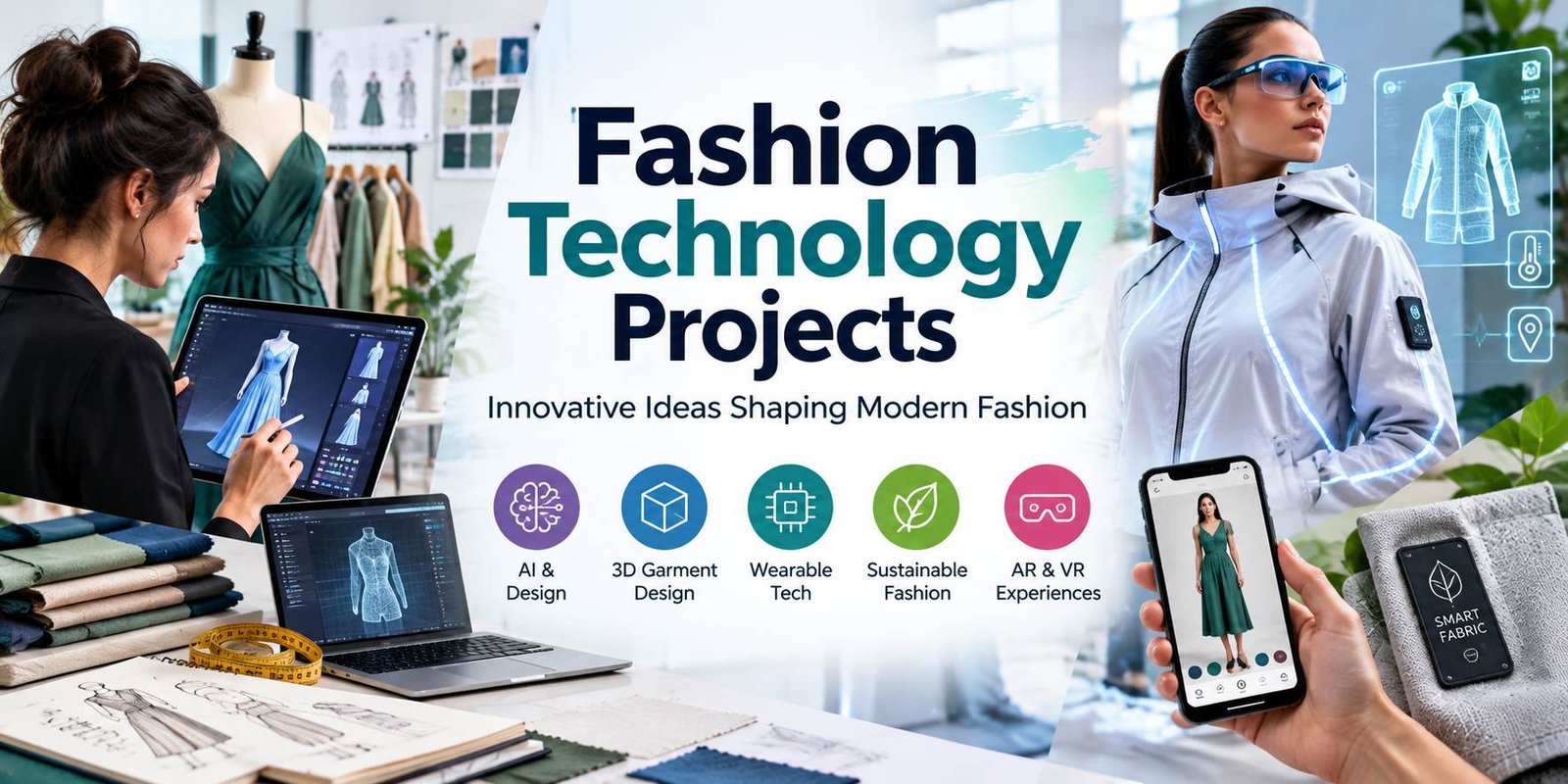
Fashion Technology Projects: Innovative Fashion Ideas
Fashion isFashion Technology Projects: Innovative Ideas Shaping Modern Fashion
Fashion Technology Projects combine clothing, design, and modern technology to create practical and creative solutions for the fashion industry. These projects can involve artificial intelligence, 3D garment design, wearable devices, smart textiles, virtual fashion, augmented reality, or sustainable production tools. They are useful for students, designers, businesses, and anyone interested in how technology is changing the way fashion is designed, produced, and experienced.
Fashion is no longer limited to fabric, sewing, and traditional design. Digital tools now allow creators to test clothing virtually, develop new materials, personalize shopping experiences, and explore ideas that were difficult to achieve with traditional methods.
In this guide, we will explore different Fashion Technology Projects, from beginner-friendly digital ideas to advanced concepts involving AI, smart clothing, 3D design, and sustainable fashion technology.
What Are Fashion Technology Projects?
Fashion Technology Projects are practical ideas that combine clothing or fashion design with digital tools, engineering, software, electronics, or modern manufacturing methods.
The goal can be creative, educational, commercial, or problem-solving.
For example, a student could create a concept for a jacket that uses sensors to monitor temperature. Another project might use 3D software to create clothing without producing a physical sample. A different idea could use artificial intelligence to recommend outfits based on a person’s wardrobe.
Fashion technology is a broad field, so projects can range from simple design exercises to advanced prototypes.
Common areas include:
- Digital fashion design
- 3D garment development
- Wearable technology
- Smart textiles
- Artificial intelligence
- Augmented and virtual reality
- Fashion e-commerce technology
- Sustainable production
- Clothing customization
- Automated manufacturing
- Digital fashion shows
- Supply chain technology
The best project is usually one that connects technology with a clear fashion-related need.
Why Fashion Technology Projects Matter
Technology can help fashion businesses work faster, reduce waste, improve customer experiences, and create products that were difficult to imagine in the past.
Traditional fashion development often requires multiple physical samples. Each sample takes materials, labor, time, and transportation.
Digital tools can reduce some of this work by allowing designers to test ideas on a computer before creating a physical garment.
Technology can also help customers interact with fashion in new ways. Virtual try-on tools, personalized recommendations, and digital clothing experiences are examples of how technology can change shopping.
For students, these developments create opportunities to learn skills from several fields at once.
Fashion Technology Projects Using 3D Design
3D design is one of the most useful areas for fashion technology projects.
Instead of drawing only on paper, designers can build digital garments and view them on virtual bodies.
Digital Garment Modeling
A project can focus on creating a virtual version of a dress, jacket, skirt, or pair of trousers.
Students can experiment with:
- Garment shapes
- Fabric appearance
- Colors
- Patterns
- Layering
- Fit
- Proportions
The digital model can be adjusted without cutting new fabric.
This makes 3D design useful for experimentation and learning.
Virtual Sample Development
A more advanced project can examine how digital samples could reduce the number of physical prototypes needed during product development.
The student could compare a traditional sampling process with a digital workflow.
The project might measure:
- Number of physical samples
- Material used
- Development time
- Design changes
- Potential waste
This creates a project that combines fashion design with practical analysis.
Fashion Technology Projects With Artificial Intelligence
Artificial intelligence has opened new possibilities for fashion businesses and designers.
AI can process large amounts of information and identify patterns that may be difficult to notice manually.
AI Outfit Recommendation
One project idea is an outfit recommendation system.
The user could enter information such as:
- Occasion
- Weather
- Preferred colors
- Clothing already owned
- Personal style
The system could then suggest possible outfit combinations.
A beginner project could use simple rules rather than a complex AI model. For example, if the occasion is formal, the system could prioritize tailored clothing and dress shoes.
A more advanced version could analyze images and recognize clothing categories.
AI-Assisted Design Ideas
Another project could explore how AI generates fashion concepts from written descriptions.
A user might enter a prompt describing a futuristic jacket, and the system could produce several visual concepts.
The important part of the project is not simply generating images. Students can study how human designers review, modify, and improve machine-generated ideas.
This raises interesting questions about creativity, originality, and the role of designers.
Trend Analysis With AI
AI can also be used to organize fashion-related data.
A project could examine images, product information, or public fashion discussions to identify repeated colors, shapes, or clothing categories.
The final result could show which characteristics appear most often within the selected dataset.
Students should clearly explain the limits of their data because a small sample cannot represent the entire fashion market.
Wearable Technology Fashion Projects
Wearable technology combines clothing or accessories with electronic components.
These projects can be particularly interesting because the technology becomes part of something people can wear.
Smart Jacket Concept
A smart jacket project could explore features such as temperature sensing, lighting, location support, or emergency alerts.
The project does not need to create a fully commercial product. A prototype or detailed concept can be enough for an educational assignment.
Students can explain:
- What problem the jacket solves
- Where sensors would be placed
- How the user interacts with the technology
- How the electronics receive power
- How the garment remains comfortable
This turns a fashion idea into a product design challenge.
Safety Wearables
Another project could explore clothing designed to improve visibility during outdoor activities.
For example, reflective elements or electronic lighting could be integrated into jackets, bags, or accessories.
The project could examine visibility, comfort, battery requirements, and appearance.
This demonstrates that wearable fashion can have a practical purpose rather than being purely decorative.
Smart Textile Fashion Technology Projects
Smart textiles are materials that can interact with their surroundings or respond to certain conditions.
They can involve sensors, conductive materials, color-changing features, or other technologies.
Temperature-Responsive Clothing
A project could investigate clothing that responds to changes in temperature.
The concept might explore materials or electronic systems that adjust the garment’s behavior when conditions change.
Students can research how the technology works and then design a fashion concept around it.
Interactive Clothing
Interactive garments can respond to movement, touch, sound, or light.
For example, a dress could include small lights that change based on movement.
The project could focus on creating the design concept, testing a simple prototype, or explaining how the electronic system would operate.
This type of project combines fashion creativity with basic electronics.
Sustainable Fashion Technology Projects
Technology can also support efforts to reduce waste and use resources more efficiently.
Sustainability-focused projects are especially useful because they connect fashion innovation with environmental concerns.
Digital Sampling Project
A student could investigate whether digital garment samples can reduce the need for physical prototypes.
The project could compare the traditional and digital processes.
Possible measurements include:
- Material consumption
- Sample quantity
- Development time
- Design revision time
- Estimated waste
The final report could explain where digital methods appear most useful and where physical samples may still be necessary.
Textile Waste Sorting
Another idea is a system that helps identify different textile materials for sorting or recycling.
A basic prototype could use image recognition to classify fabric categories.
The project could explain the challenges of identifying mixed fabrics and damaged garments.
Upcycling Design Tool
A technology project could help users find new uses for old clothing.
For example, a digital tool might ask users what garments they have and suggest possible redesign ideas.
An old shirt could become a tote bag, a skirt, or another useful item depending on its fabric and construction.
This combines software with circular fashion thinking.
Fashion Technology Projects for Virtual Reality
Virtual reality can create immersive fashion experiences.
Instead of simply looking at clothing on a website, users could enter a digital environment and interact with garments or fashion collections.
Virtual Fashion Show
A student project could create a concept for a fashion show inside a virtual environment.
The project could include:
- Digital models
- Virtual garments
- Runway design
- Lighting
- Music
- Audience interaction
The student could explain how a virtual event differs from a traditional runway show.
Virtual Fashion Store
Another project could explore a digital store where customers walk through a virtual environment and inspect clothing.
Users might select an item, view different colors, or examine styling combinations.
The project can focus on user experience rather than building a complete commercial platform.
Augmented Reality Fashion Projects
Augmented reality adds digital information to the user’s real-world view.
This technology can be useful for fashion shopping and styling.
Virtual Try-On
A virtual try-on project could allow users to see how an item might look without physically wearing it.
A simple concept could use a camera and digital overlay.
More advanced systems can attempt to estimate body position and clothing placement.
The project should also discuss limitations. Digital fitting may not perfectly predict real-world comfort, fabric behavior, or physical fit.
AR Styling Assistant
An augmented reality styling tool could show accessories or clothing combinations on a user’s image.
For example, someone could preview different jacket colors or handbag styles.
The goal would be to make product exploration more interactive.
Fashion E-Commerce Technology Projects
Online fashion shopping creates another large area for technology projects.
Personalized Product Recommendations
An online store can recommend products based on browsing behavior, previous purchases, preferences, or product similarities.
A student project could build a simple recommendation system using a small product dataset.
The system might recommend items based on color, category, price range, or style.
Size Recommendation Tool
Finding the correct clothing size online can be difficult.
A technology project could explore a system that recommends a size using measurements and brand-specific size information.
The project should clearly explain that sizing differs between brands and garment types.
Smart Search for Fashion Stores
A normal search system may require users to type exact product names.
A smarter fashion search could understand descriptions such as:
“black casual dress for summer under $80.”
The system could then filter products based on color, style, season, and price.
This demonstrates how natural-language technology can improve online shopping.
Fashion Technology Projects With Robotics
Robotics can be connected to fashion manufacturing in several ways.
Factories may use automated systems for cutting, handling materials, inspection, or other repetitive tasks.
A student project could investigate one specific production task and explore whether automation could improve speed or consistency.
Automated Fabric Cutting
A project could examine how computer-controlled cutting systems work.
The student might design a theoretical workflow that takes digital pattern pieces and arranges them efficiently on fabric.
The objective could be to reduce unused material.
Automated Quality Inspection
Another project could explore computer vision for detecting problems in garments.
The system could attempt to identify:
- Missing stitches
- Uneven seams
- Fabric marks
- Incorrect labels
- Color differences
A prototype could use sample images rather than a real factory system.
Fashion Technology Projects for Students
Students do not need advanced equipment to create an interesting fashion technology project.
A strong project begins with a clear question.
For example:
How can technology reduce clothing sample waste?
Or:
Can a digital styling tool help users create more outfits from fewer garments?
Once the question is clear, the student can decide what technology is appropriate.
Beginner Project Ideas
Simple projects could include:
- Digital outfit planner
- Fashion trend survey
- Clothing recommendation flowchart
- Virtual wardrobe concept
- Sustainable shopping calculator
- Fashion brand comparison dashboard
- Digital fashion mood board
These projects focus on research, design, and simple digital tools.
Intermediate Project Ideas
Students with more technical skills could explore:
- AI outfit recommendations
- Image-based clothing classification
- AR accessories
- Digital garment prototypes
- Smart textile concepts
- Clothing size recommendation tools
The project should remain focused rather than trying to combine every technology at once.
How to Choose a Fashion Technology Project
Choosing a topic can be harder than building the project.
Start with a problem rather than a technology.
Instead of saying, “I want to use AI,” ask:
What fashion problem could AI help solve?
The answer might involve styling, product discovery, trend research, sizing, or inventory planning.
Next, consider the resources available.
A project requiring specialized sensors may not be practical if you only have a laptop. In that situation, a digital prototype or research-based concept may be more suitable.
Finally, define a clear result.
A good project might produce:
- A working prototype
- A digital design
- A research report
- A mobile app concept
- A website
- A product demonstration
- A data analysis
- A user testing report
Steps for Building a Fashion Technology Project
A clear process can make the project easier to manage.
Step 1: Identify the Problem
Choose one specific fashion-related issue.
Avoid starting with an overly broad topic such as “the future of fashion.”
A narrower problem is easier to investigate.
Step 2: Research Existing Solutions
Find out what technologies or products already address the problem.
This prevents you from designing something without understanding the existing market.
Step 3: Define the User
Decide who would use your project.
The user could be a shopper, designer, student, retailer, manufacturer, or fashion enthusiast.
Step 4: Build a Basic Version
Start small.
A simple prototype can reveal problems before you spend time developing advanced features.
Step 5: Test the Idea
Ask potential users to try the prototype or review the concept.
Record what they understand, what confuses them, and what they would change.
Step 6: Improve the Design
Use the feedback to make practical improvements.
This stage is often where a basic idea becomes a stronger project.
Benefits of Combining Fashion and Technology
Fashion technology projects can create benefits in several areas.
Faster Design Development
Digital tools can allow designers to experiment quickly.
Reduced Material Use
Virtual prototypes may reduce the need for some physical samples.
Better Customer Experiences
Virtual fitting, personalized recommendations, and interactive shopping can make online fashion more engaging.
New Creative Opportunities
Technology can give designers new ways to work with movement, light, sound, data, and digital environments.
More Accessible Learning
Digital design tools allow students to experiment without requiring a complete fashion studio.
Challenges of Fashion Technology Projects
Technology also introduces difficulties.
Cost can be a problem when projects require specialized hardware or software.
Technical skills may also be necessary. A designer might understand clothing construction but need help with programming or electronics.
There are also questions about privacy, especially when projects use body measurements, photographs, or customer behavior.
AI-generated fashion concepts raise questions about originality and creative ownership.
Sustainable technology can also have trade-offs. A digital or electronic product may reduce one type of environmental impact while creating another.
A strong project should acknowledge these limitations rather than presenting technology as a perfect solution.
The Future of Fashion Technology Projects
The relationship between fashion and technology is likely to become more connected.
Designers may use increasingly advanced digital tools before producing physical garments. Smart clothing may become more practical for health, sports, safety, and communication. Online stores may use better personalization and virtual product experiences.
Sustainability will also remain an important area for innovation.
The most valuable projects will not simply add technology for decoration. They will use technology to solve meaningful problems.
A successful fashion technology idea could make clothing easier to design, easier to customize, easier to understand, or more efficient to produce.
Frequently Asked Questions About Fashion Technology Projects
What are Fashion Technology Projects?
They are projects that combine fashion with technologies such as software, artificial intelligence, electronics, 3D design, smart textiles, augmented reality, or digital manufacturing.
Which fashion technology project is good for beginners?
A digital wardrobe planner, outfit recommendation tool, fashion trend dashboard, or virtual fashion concept can be a good starting point because these projects can be developed with relatively simple tools.
Can fashion students create technology projects?
Yes. Fashion students can work with digital design, wearable technology, sustainability tools, virtual fashion, AI concepts, and online shopping systems.
Does a fashion technology project need coding?
Not always. Some projects can focus on research, product design, digital modeling, user experience, or visual prototypes. Coding becomes more important when building interactive software.
How can technology make fashion more sustainable?
Technology may help reduce physical sampling, improve production planning, optimize material use, support textile sorting, and help consumers make more informed choices.
What is the most important part of a fashion technology project?
A clear problem is usually more important than using an advanced technology. The project should explain who has the problem, how the proposed solution works, and why it could be useful.
Conclusion
Fashion Technology Projects show how clothing and technology can work together to create new solutions. Digital design, artificial intelligence, smart textiles, wearable devices, virtual reality, augmented reality, and sustainable production tools are opening new possibilities for the fashion industry.
For students, these projects offer a chance to combine creative thinking with technical skills. For businesses, they can provide new ways to improve design, manufacturing, shopping, and customer experiences.
The strongest projects do not use technology simply because it is new. They begin with a real problem and then select the right tool to address it.
Whether the idea is a simple digital wardrobe planner or an advanced smart garment, the most important goal is to create something useful, understandable, and realistic. As fashion continues to evolve, projects that connect creativity with practical technology may play an important role in shaping what people wear next.



One Comment