
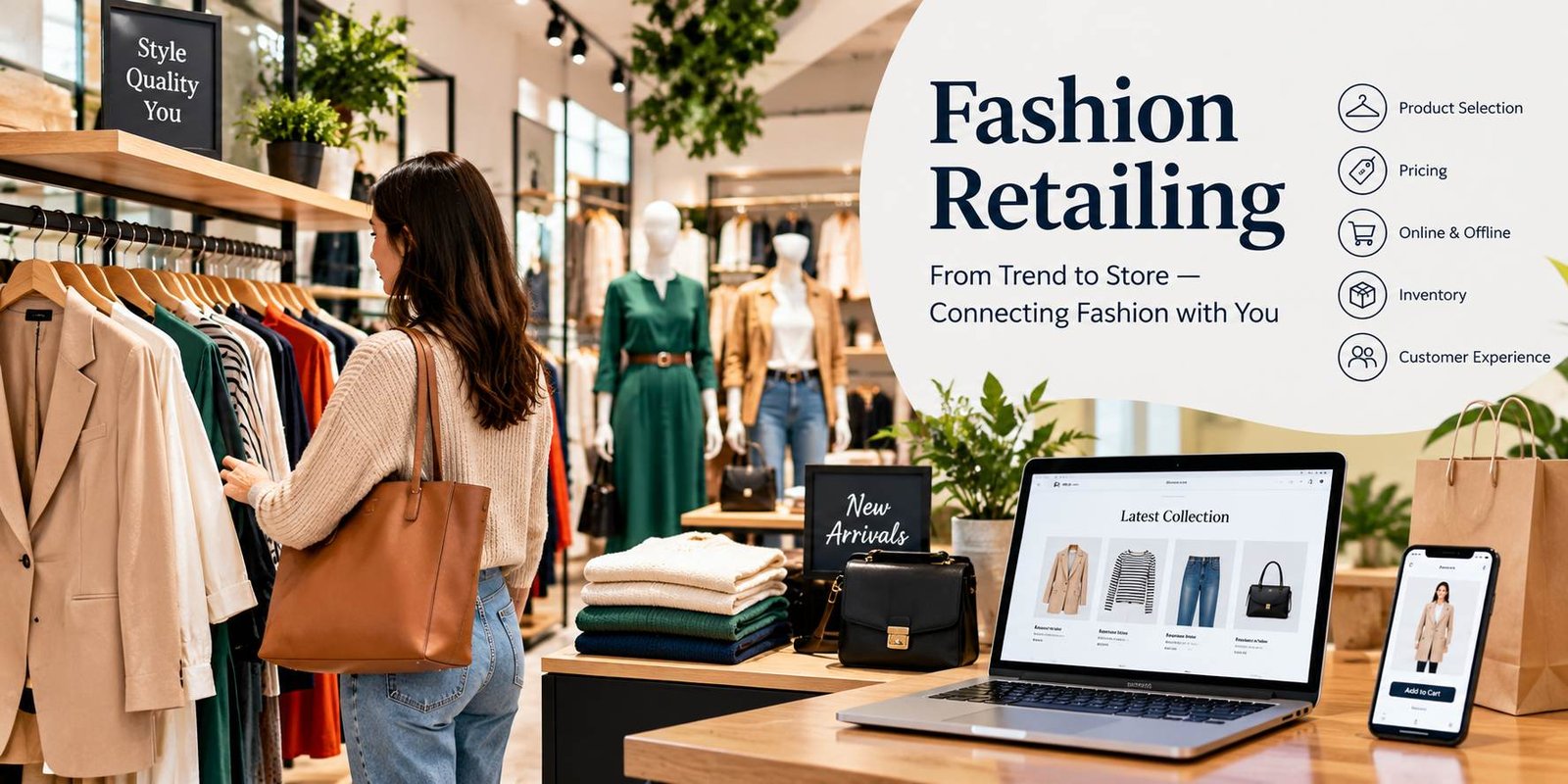
Fashion Retailing: A Complete Guide to Modern Fashion Retail
Fashion retailing is the part of the fashion industry that connects clothing, accessories, footwear, and other style products with the people who want to buy them. It covers much more than operating a clothing store. Retailers decide what products to offer, how to display them, where to sell them, how to price them, and how to create a shopping experience that encourages customers to return.
A fashion retailer might operate a neighborhood boutique, a large department store, an online shop, a temporary pop-up, or a combination of several channels. The basic goal remains similar: put the right products in front of the right shoppers at a suitable time and price.
However, successful retailing requires constant judgment. A retailer can have attractive clothing and still struggle if the products arrive at the wrong time, prices do not match customer expectations, inventory becomes difficult to manage, or the shopping experience feels confusing.
Understanding how fashion retailing works helps explain what happens between a designer creating a collection and a customer taking a garment home.
What Is Fashion Retailing?
Fashion retailing refers to the business activities involved in selling fashion products directly to consumers. These products can include clothing, shoes, handbags, jewelry, accessories, and other style-related goods.
The retailer sits between the supply side of the industry and the customer. Depending on the business model, a retailer may purchase finished products from brands or wholesalers, sell products under its own label, or work with manufacturers to create merchandise specifically for its store.
For example, imagine a retailer preparing for the fall season. The team might review customer preferences, examine previous sales, choose new products, negotiate orders, plan prices, prepare store displays, photograph products for the website, and organize promotional campaigns.
All of those decisions form part of retailing.
The work continues after a customer makes a purchase. Returns, customer service, inventory tracking, product reviews, and future buying decisions all provide information that can influence the retailer’s next move.
Why Fashion Retailing Is Different From Ordinary Retail
Fashion has an unusual relationship with timing and personal taste.
A basic household product may remain useful for years with relatively little change. Fashion merchandise can lose appeal because a season changes, a color becomes less popular, or customers move toward a different silhouette.
This creates a challenge for retailers. They must estimate demand before they know exactly what shoppers will want.
There is also an emotional element. Customers do not always buy clothing because they need another shirt or pair of shoes. They may purchase something because it fits their identity, suits an upcoming occasion, or simply feels right when they try it on.
That means fashion retailers have to understand both practical needs and personal preferences.
How the Fashion Retailing Process Works
The retail process begins long before a product reaches a sales floor.
1. Understanding the Customer
Retailers first need a clear idea of who they are serving.
A store aimed at college students will likely make different product choices from a boutique focused on professional workwear. Factors such as age group, budget, location, lifestyle, climate, and shopping habits can influence merchandise decisions.
Customer research can come from sales data, surveys, product reviews, website behavior, store observations, and direct conversations.
The objective is not to predict every individual purchase. Instead, retailers look for useful patterns.
2. Selecting Merchandise
Once the target customer is understood, buyers decide which products should enter the assortment.
They may consider:
- Product style
- Fabric and construction
- Expected demand
- Price range
- Seasonal relevance
- Available sizes
- Color choices
- Supplier reliability
- Expected profit
A balanced assortment can include basic pieces alongside more distinctive items. For instance, a women’s clothing retailer might stock everyday trousers and simple tops while also carrying a smaller selection of statement jackets.
The mix gives customers practical choices without making the store feel repetitive.
3. Setting Prices
Pricing is more complicated than adding a fixed amount to the cost of a garment.
Retailers need to consider production or wholesale costs, operating expenses, customer expectations, competing products, brand positioning, and the desired profit margin.
A premium boutique may charge more because of its materials, design, service, location, or brand image. A discount retailer uses a different model and may depend on higher sales volume.
The important point is that price communicates information. Shoppers often use it as one signal of quality, positioning, and value.
Store-Based Fashion Retailing
Physical stores remain important because clothing is highly visual and tactile.
A customer can touch fabric, compare colors, inspect stitching, try on different sizes, and see how a garment fits in a mirror. Those experiences are difficult to reproduce perfectly through a screen.
Store layout also influences shopping behavior.
A retailer might place new arrivals near the entrance, organize products by category, create complete outfit displays, or position accessories near complementary garments.
For example, showing a blazer beside trousers and a simple blouse can help shoppers imagine an entire outfit rather than evaluating each item separately.
Visual Merchandising
Visual merchandising is the practice of presenting products in a way that attracts attention and makes shopping easier.
It includes:
- Window displays
- Product arrangement
- Mannequins
- Lighting
- Signage
- Color coordination
- Store fixtures
- Promotional displays
Good merchandising should guide customers without making the store feel overly complicated.
A display featuring five carefully selected garments can sometimes communicate an idea more effectively than a crowded wall filled with dozens of products.
Online Fashion Retailing
E-commerce has changed how customers discover and purchase fashion.
An online fashion store cannot rely on physical touch or fitting rooms. Instead, it needs detailed product information and strong visual presentation.
Useful product pages often include:
- Multiple photographs
- Size information
- Fabric details
- Care instructions
- Fit guidance
- Product measurements
- Shipping information
- Return policies
Photography is especially important. Customers need enough views to understand the garment’s shape, texture, color, and proportions.
Descriptions should also answer practical questions rather than simply using promotional language.
For example, telling a customer that a jacket has a relaxed fit and falls below the hip is more useful than simply calling it “stylish.”
Omnichannel Fashion Retailing
Many retailers now operate across several sales channels rather than treating the physical store and website as completely separate businesses.
A shopper might discover a product on social media, examine it on a website, visit a store to try it on, and later complete the purchase through a mobile device.
This creates an omnichannel shopping journey.
Retailers may connect their channels through services such as:
- Online ordering with store pickup
- Store returns for online purchases
- Shared loyalty programs
- Unified inventory systems
- Digital receipts
- Mobile shopping tools
The challenge is consistency. Customers should not feel as if they are dealing with completely different businesses depending on which channel they use.
The Role of Fashion Buyers
Fashion buyers have a major influence on what customers eventually see.
Their job involves selecting merchandise that fits the retailer’s customer and commercial strategy. They may review supplier information, attend trade events, examine samples, compare costs, and monitor previous sales.
A buyer must balance creativity with commercial judgment.
Ordering too little can lead to missed sales when an item becomes popular. Ordering too much can leave the retailer with excess inventory that may eventually require markdowns.
For this reason, buying decisions often involve uncertainty.
A successful buyer does not simply select attractive products. They think about how those products fit into the retailer’s wider assortment.
Inventory Is a Major Retail Challenge
Fashion inventory can become expensive when products remain unsold.
Imagine a retailer ordering a large quantity of a particular seasonal coat. If the weather stays unusually warm, customers may delay buying coats. The retailer then has merchandise occupying storage space while the selling window becomes shorter.
Inventory management helps retailers monitor what is selling, what is moving slowly, and what needs attention.
Retailers may use sales records and inventory software to track stock levels and identify patterns.
The goal is not always to have the largest possible selection. The goal is to maintain an assortment that supports customer demand without creating unnecessary excess.
Fashion Retailing and Customer Experience
Two stores can sell similar products but create very different shopping experiences.
Customer experience includes everything from entering the store to receiving an order after an online purchase.
Important details can include:
- Ease of finding products
- Staff assistance
- Checkout speed
- Website navigation
- Delivery communication
- Return procedures
- Packaging
- After-sales support
Small frustrations can affect how customers view a retailer.
For example, an online store may have excellent clothing but lose potential buyers if size information is difficult to find. Similarly, a physical store may carry strong merchandise but feel uncomfortable if customers cannot move easily through crowded displays.
The Growing Role of Data
Retailers have access to more information than ever before.
Sales records can show which products perform well. Website analytics can reveal which pages receive attention. Search behavior can indicate what shoppers are looking for. Customer feedback can identify recurring problems.
Data can support decisions, but it should not replace human judgment.
Suppose a retailer notices that one color has generated strong online interest. That information may justify ordering more of it, but the retailer still needs to consider season, customer demographics, inventory levels, and the rest of the collection.
Numbers provide clues. Merchandising decisions still require context.
Social Media and Fashion Retail
Social platforms have become important discovery spaces for fashion.
Customers may encounter a garment through a creator’s outfit, a brand campaign, a short video, or a customer photograph. The path from discovery to purchase can be much shorter than it was when shoppers depended mainly on physical stores and traditional advertising.
Retailers can use social media to show products in realistic settings, explain styling ideas, introduce new collections, and respond to customer questions.
Authenticity matters, though. Constantly pushing products can make an account feel like a catalog. Useful styling content, behind-the-scenes material, and customer-focused information can make the retail brand more engaging.
Sustainable Choices in Fashion Retail
Retailers also face growing questions about waste, materials, packaging, product life, and purchasing practices.
Sustainability does not have one simple solution. Different retailers may approach it in different ways.
Possible efforts include:
- Reducing unnecessary packaging
- Choosing longer-lasting products
- Improving inventory planning
- Offering repair services
- Supporting resale programs
- Selecting materials with lower environmental impact
- Reducing unnecessary overproduction
Retailers should be careful with environmental claims. Statements about sustainability need to be specific and supportable rather than vague marketing language.
A retailer that says a product uses recycled material should clearly explain what that means instead of presenting the entire product as automatically sustainable.
Common Challenges in Fashion Retailing
Fashion retailers deal with several risks at once.
Changing preferences: A product that looks promising during planning may not attract enough customers.
Inventory pressure: Unsold seasonal goods can become difficult to sell at their original price.
Competition: Customers can compare products and prices across many stores within minutes.
Returns: Online fashion purchases may have higher uncertainty because customers cannot physically try products before ordering.
Supply problems: Delays can cause merchandise to arrive after its most useful selling period.
Customer expectations: Shoppers increasingly expect convenient service, clear information, and flexible purchasing options.
These challenges make planning important, but flexibility matters just as much.
How Small Fashion Retailers Can Compete
Independent retailers do not necessarily need to match large companies in product volume.
A smaller business can compete through specialization.
For example, a boutique might focus on carefully selected workwear for women who want polished clothing without overly formal designs. Another retailer could specialize in occasion dresses, sustainable basics, vintage-inspired pieces, or locally produced accessories.
A focused assortment can make the shopping experience easier because customers know what the store is designed to offer.
Personal service can also become a strength. Staff who understand the products can help shoppers find sizes, suggest combinations, and explain fabric or care details.
The Future of Fashion Retailing
Fashion retailing will continue to blend physical shopping with digital experiences.
Customers may move between websites, stores, social platforms, mobile devices, and other channels during a single purchase journey. Retailers will need systems that keep product information, inventory, pricing, and customer service consistent across those touchpoints.
Technology can improve convenience, but the fundamentals remain familiar.
Customers still want products that fit their needs, prices that make sense, useful information, and a shopping experience they can trust.
Retailers that combine thoughtful merchandising with accurate data and responsive customer service are better positioned to adapt as shopping habits change.
Final Thoughts
Fashion retailing connects the creative side of fashion with everyday buying decisions. It involves far more than putting clothes on racks or uploading product photographs. Retailers must understand customers, select useful merchandise, manage inventory, set appropriate prices, create appealing presentations, and provide dependable service.
The strongest retail strategy is rarely built around one perfect product. It comes from making many connected decisions work together.
A well-chosen collection needs the right price. The right price needs clear presentation. Good presentation needs convenient purchasing. And a successful purchase can become the beginning of a longer relationship with the customer.
That combination of product, timing, presentation, technology, and service is what makes fashion retailing such an important part of the fashion industry.



One Comment