
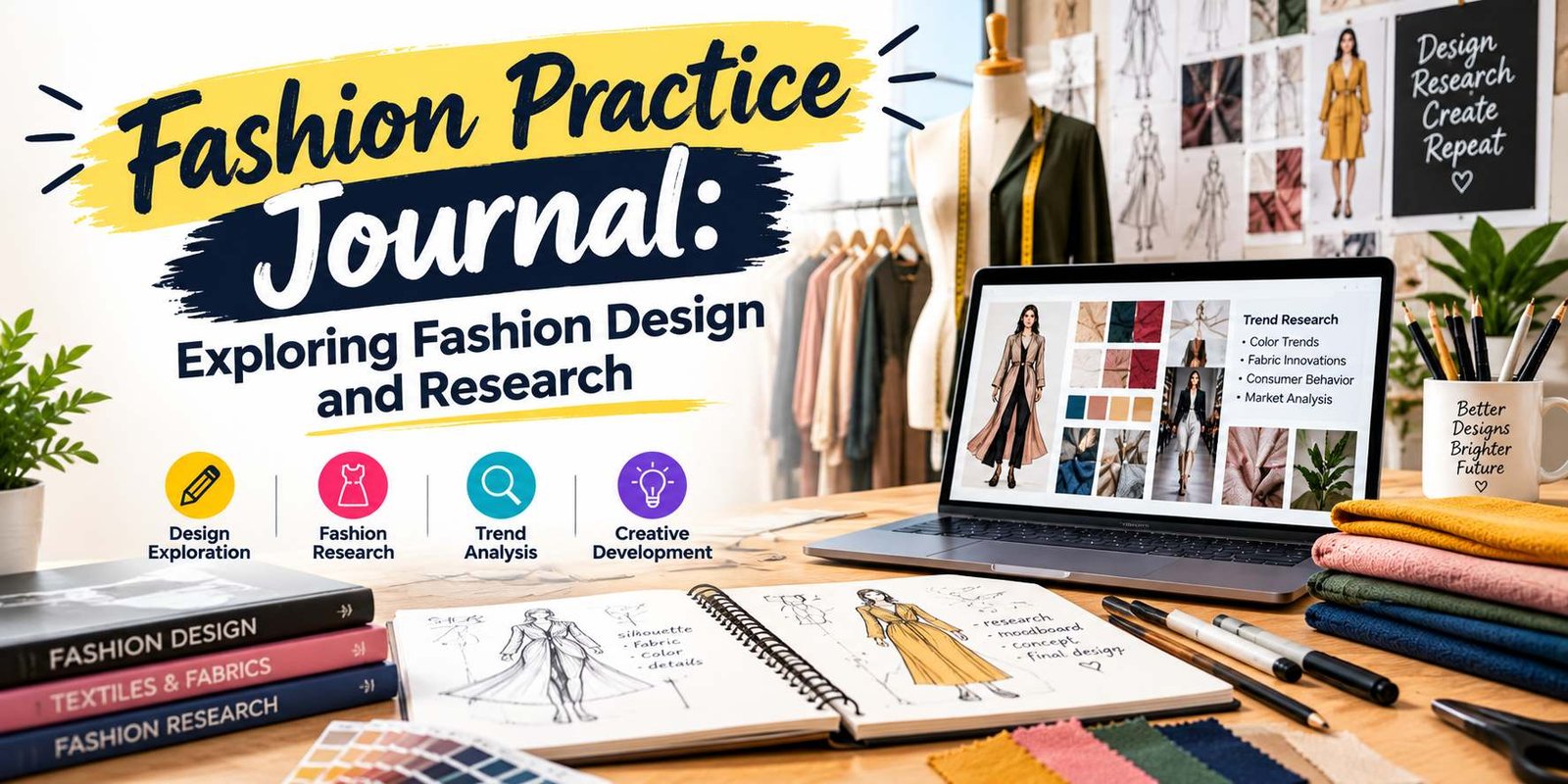
Fashion Practice Journal: Exploring Fashion Design and Research
Fashion is more than the clothes people wear. It is a creative field that connects design, culture, identity, technology, and everyday life. Designers study fabrics, test new ideas, explore cultural influences, and find better ways to create clothing. A fashion practice journal can help readers understand these activities and how they shape modern fashion.
For students, designers, researchers, and fashion enthusiasts, this topic offers a useful way to explore the connection between creative work and academic research. It also helps explain how fashion ideas move from early sketches and experiments to finished garments and wider industry trends.
In this guide, we will explore the meaning of a fashion practice journal, its role in fashion education, the subjects it may cover, and the ways creative professionals can use research to improve their work.
What Is a Fashion Practice Journal?
A fashion practice journal is a publication or research resource that explores fashion through practical work, creative experiments, critical discussion, and design research. Depending on the publication, it may include academic articles, case studies, visual projects, interviews, and discussions about the fashion industry.
The term can also describe a personal journal that a designer or student uses to record ideas, experiments, observations, and progress. Therefore, its meaning depends on the context in which it appears.
In an academic setting, fashion practice often focuses on learning through making. A designer might develop a garment, test several materials, document the results, and explain how the process influenced the final design.
This approach connects creative practice with reflection. Instead of presenting only a finished product, the designer also considers the decisions, problems, and discoveries that shaped it.
A fashion practice journal may explore questions such as:
- How can traditional clothing techniques inspire modern design?
- What makes a garment practical as well as visually appealing?
- How can designers reduce textile waste?
- How does clothing communicate personal or cultural identity?
- How can digital tools improve the design process?
These questions show why fashion practice can be relevant to both creative professionals and academic researchers.
Why Fashion Practice Matters in the Modern Industry
The fashion industry changes as consumer needs, technology, materials, and cultural attitudes evolve. Designers must understand these changes while developing products that are attractive, useful, and suitable for their intended audience.
Fashion practice encourages professionals to test ideas instead of relying entirely on assumptions. For example, a designer creating a lightweight summer jacket might compare different fabrics, examine how each material feels against the skin, and test how well it performs in warm weather.
The results can influence the garment’s construction, fit, and final appearance.
Connecting Ideas With Real Design Work
Fashion concepts often begin with inspiration from art, architecture, nature, music, or historical clothing. However, an interesting concept does not automatically become a successful garment.
Practical testing helps designers discover whether an idea works in real life. A dramatic sleeve may look attractive in a sketch but restrict movement when someone wears it. A textured fabric may appear beautiful but require special care that some customers would prefer to avoid.
By documenting these discoveries, designers can understand why certain choices succeed and others need improvement.
Supporting Better Fashion Education
Fashion students need more than drawing skills. They also need to understand pattern cutting, garment construction, textiles, research, presentation, and problem-solving.
A practice-based approach helps students connect these subjects. They can document their research, explain their design choices, and evaluate their results.
This process also prepares them to discuss their work with teachers, clients, employers, and collaborators.
Main Topics Covered in Fashion Practice Research
Fashion practice is a broad field. Different journals and research publications may focus on different areas, depending on their editorial goals and audience.
The following subjects are particularly useful for understanding the relationship between fashion and practical creative work.
1. Fashion Design and Garment Development
Fashion designer choosing colors for new collection
Fashion design research examines how clothing ideas develop from initial concepts into finished products.
A designer may begin with a mood board, collect visual references, create sketches, and select suitable fabrics. The next steps may include pattern development, sample production, fitting, and adjustments.
Research into this process can explain how design decisions affect comfort, appearance, durability, and production costs.
For example, a designer creating a versatile work jacket might investigate pocket placement, fabric weight, lining options, and different closure systems. Each choice affects how the garment looks and functions.
Recording these decisions makes it easier to review the design and improve future collections.
2. Textile Research and Material Innovation
Textiles influence the appearance, feel, performance, and lifespan of clothing. For this reason, fabric research is an important part of fashion practice.
Designers may study natural fibers, synthetic materials, recycled textiles, knitted structures, woven fabrics, and experimental surfaces.
They may compare materials according to:
- Strength and durability
- Breathability and comfort
- Stretch and recovery
- Washing and care requirements
- Cost and availability
- Environmental impact
Material experiments can reveal unexpected opportunities. For instance, combining two fabrics may improve flexibility, while changing a garment’s lining may make it more comfortable.
A practice journal can document these experiments and explain why a particular material was selected.
3. Sustainable Fashion and Responsible Design
Sustainability has become an important subject in fashion research because clothing production and consumption can create waste, use natural resources, and contribute to environmental pollution.
Fashion researchers explore practical ways to reduce these impacts. Their work may examine durable construction, recycled fibers, repair services, garment rental, resale, and circular design.
A designer might create a jacket with replaceable buttons, reinforced seams, and a timeless shape. These choices can help extend the garment’s useful life.
Another project might investigate how leftover fabric can be used to produce accessories rather than being discarded.
However, sustainable claims need careful evaluation. A material described as eco-friendly may still require substantial water, energy, or chemical processing. Research should consider the full production process whenever reliable information is available.
4. Fashion, Culture, and Personal Identity
Clothing can communicate cultural heritage, social belonging, professional identity, and personal taste. Fashion practice research often explores how these meanings influence design.
Traditional embroidery, regional textiles, historic silhouettes, and ceremonial clothing can inspire contemporary collections. Researchers may examine how designers adapt these influences while respecting their cultural origins.
For example, a collection inspired by traditional weaving might use a familiar textile technique in modern jackets or everyday accessories.
Responsible research involves understanding the technique’s history, acknowledging relevant communities, and avoiding misleading claims about cultural symbols.
This subject demonstrates that fashion design is not only about appearance. It also involves meaning, representation, and the relationship between clothing and society.
How to Use a Fashion Practice Journal for Design Projects
A fashion practice journal can be useful whether it refers to an academic publication or a personal record of creative work. Reading published research provides knowledge, while maintaining a personal journal helps designers apply that knowledge.
A structured process makes both activities more effective.
Step 1: Define the Research Question
Start with a clear question rather than collecting unrelated inspiration.
For example, a student developing a summer collection might ask: Which lightweight fabrics offer a suitable balance of comfort, durability, and appearance?
A focused question makes it easier to decide which sources, materials, and experiments are relevant.
Step 2: Gather Reliable References
Collect information from books, academic publications, museum collections, textile suppliers, and credible industry sources.
When using a published fashion practice journal, review its scope and the type of research it publishes. Check the author, publication date, references, and methods used.
Do not assume that every website using the words “fashion journal” is an academic publication. Some are magazines, blogs, or personal portfolios.
Step 3: Record Experiments
Document sketches, fabric samples, construction methods, measurements, and test results.
A useful entry should explain what was tested and what happened. If a fabric shrinks after washing, record the conditions and the measured change rather than simply writing that the fabric did not work.
Photographs can also help show how a design changes during development.
Step 4: Evaluate the Results
After each experiment, consider what the findings mean.
Did the material behave as expected? Was the garment comfortable? Did the pattern require changes? Could the process be completed within the available budget?
Honest evaluation is valuable because unsuccessful experiments can reveal important information.
Step 5: Apply What You Learn
Use the results to refine the design, choose more suitable materials, or change the construction method.
The final record should connect the original question, research, experiments, findings, and design decisions. This makes the process easier to understand and repeat.
The Role of Technology in Fashion Practice
Digital tools have changed how designers research, develop, present, and evaluate fashion products.
Computer-aided design software can help designers create technical drawings and adjust patterns. Three-dimensional garment software can provide digital previews before a physical sample is made. Digital libraries make it easier to organize references, while spreadsheets can help compare materials, measurements, and costs.
Technology can also support collaboration. A design team working across different locations may share digital samples, annotate garment images, and review changes without meeting in person.
Digital Fashion and Virtual Prototypes
Three-dimensional design tools allow designers to explore garment shapes, colors, and fabric behavior in a virtual environment. Although digital previews cannot perfectly represent every physical material, they can help identify some problems before a sample is produced.
For example, a designer may notice that a jacket’s proportions look unbalanced or that a sleeve needs adjustment.
Virtual prototypes can reduce the need for certain physical samples, depending on the project and the accuracy of the software.
Artificial Intelligence in Fashion Research
Artificial intelligence can help organize large amounts of information, identify patterns in sales data, generate early design concepts, and support trend analysis.
However, AI-generated suggestions should be reviewed carefully. They may contain errors, repeat existing ideas, or overlook cultural context.
Designers should verify factual claims, respect intellectual property, and use their own judgment when deciding whether a generated concept is appropriate.
Technology works best when it supports creative thinking rather than replacing critical evaluation.
Fashion Practice Journal and Fashion Industry Trends
Research becomes more valuable when it connects with the needs of the fashion industry. Several current areas offer opportunities for practical investigation.
Slow Fashion and Garment Longevity
Slow fashion emphasizes thoughtful purchasing, quality, longer product use, and more responsible consumption.
Researchers can investigate how construction quality, repair options, timeless design, and customer education influence garment longevity.
A practical project might compare two shirts with different seam finishes and examine how they perform after repeated washing and wearing.
Inclusive Fashion Design
Inclusive design considers the needs of people with different body shapes, mobility levels, sensory preferences, and dressing requirements.
Fashion practice research may explore adjustable closures, easy-to-wear garments, flexible sizing, and adaptive clothing.
For example, a designer could test different fastening systems to determine which are easier to use for people with limited hand movement.
The aim is to make clothing more useful without treating diverse needs as an afterthought.
Digital Shopping and Customer Experience
Online shopping has created new challenges for fashion brands. Customers cannot physically touch garments or try them on before ordering.
Research may examine size charts, product photography, virtual fitting tools, garment descriptions, and return patterns.
Designers and retailers can use these findings to improve product information and help shoppers make more informed choices.
Traditional Craft and Modern Production
Many fashion projects combine traditional techniques with contemporary production methods.
A designer might study hand embroidery, natural dyeing, weaving, or regional garment construction. The research could then explore how a technique can be used in modern clothing while maintaining its distinctive qualities.
Such projects can create opportunities for collaboration between designers, craftspeople, and local producers.
How to Find a Suitable Fashion Practice Journal
If you are looking for an actual publication rather than a personal design notebook, it is important to identify the exact journal.
Search academic databases, university library catalogues, scholarly publishers, and fashion research collections. Use the full publication title whenever possible.
When evaluating a journal, consider these points:
- Subject coverage: Does it publish fashion design, creative practice, textiles, fashion theory, or industry research?
- Editorial process: Does it explain how submissions are reviewed?
- Author information: Are authors and their institutional affiliations identified?
- References: Does the publication provide sources that readers can check?
- Access: Are articles freely available, or is a subscription required?
- Relevance: Does the journal publish the kind of work you need for your project?
The exact phrase “Fashion Practice Journal” may be used informally to describe different resources. It should not automatically be treated as the official title of one specific publication.
If you need a journal for a university assignment, confirm the publication’s exact name, publisher, and academic status before citing it.
Benefits of Keeping a Fashion Research Journal
A personal journal can help students and professionals develop a clearer understanding of their creative process.
Better organization: Notes, images, material samples, and references stay connected to the project.
Stronger design decisions: Recorded experiments provide evidence for choosing a fabric, shape, finish, or construction method.
Improved problem-solving: Designers can review earlier mistakes and avoid repeating them.
Clearer communication: A documented process makes it easier to explain ideas to tutors, clients, manufacturers, and teammates.
Professional development: A well-organized record can help demonstrate research skills and design thinking in a portfolio.
The quality of a journal depends more on the usefulness of its observations than on how many pages it contains. Short, specific entries can be more valuable than long notes without clear findings.
Common Mistakes to Avoid in Fashion Practice Research
Fashion research can become less useful when the process lacks focus or reliable evidence.
One common mistake is collecting inspiration without defining a question. Images may look attractive, but they will not necessarily help solve a design problem.
Another mistake is recording conclusions without explaining how they were reached. If a designer selects a fabric, the journal should identify the factors that influenced the choice.
It is also important to distinguish personal opinion from verified information. A designer may prefer one textile because of its feel, but claims about its environmental impact require evidence.
Finally, avoid copying another designer’s work without acknowledgment. Research should build on existing knowledge while making the source of ideas clear. Originality comes from thoughtful interpretation, testing, and the development of a distinct design response.
Frequently Asked Questions
What is a fashion practice journal used for?
It can refer to a publication that explores fashion through research and practical design, or a personal journal used to record creative experiments, observations, and project development.
Who can benefit from fashion practice research?
Fashion students, clothing designers, textile researchers, educators, stylists, and industry professionals can benefit from research that connects creative ideas with practical results.
Is a fashion practice journal the same as a fashion magazine?
No. A fashion magazine usually focuses on style, trends, shopping, photography, and industry news. A fashion practice journal may focus more on design methods, critical research, experiments, and academic discussion. The exact distinction depends on the publication.
What should a fashion design journal contain?
Useful entries may include research questions, sketches, mood boards, fabric samples, construction notes, photographs, experiment results, references, and reflections on design decisions.
How does fashion practice support sustainability?
It allows designers to test methods that may reduce waste, extend garment life, improve material use, and support repair or reuse. The actual environmental benefits should be evaluated using reliable evidence.
Can beginners create a fashion practice journal?
Yes. Beginners can start with a notebook or digital document. Recording small experiments, explaining design choices, and reviewing results can help build stronger research and creative skills over time.
Conclusion
A fashion practice journal offers a useful way to explore the relationship between fashion research and creative work. Whether it is an academic publication or a personal design record, its value comes from examining ideas, testing methods, and learning from the results.
From garment construction and textile innovation to sustainability, cultural identity, and digital design, fashion practice can help explain how clothing develops and why particular design choices matter.
For students, it provides a way to document learning. For designers, it supports better decisions and more thoughtful experimentation. For researchers, it offers a framework for examining fashion as both a creative activity and an important part of modern society.
The most effective approach is to remain curious, document the process carefully, verify information, and use each project as an opportunity to learn something new.




One Comment