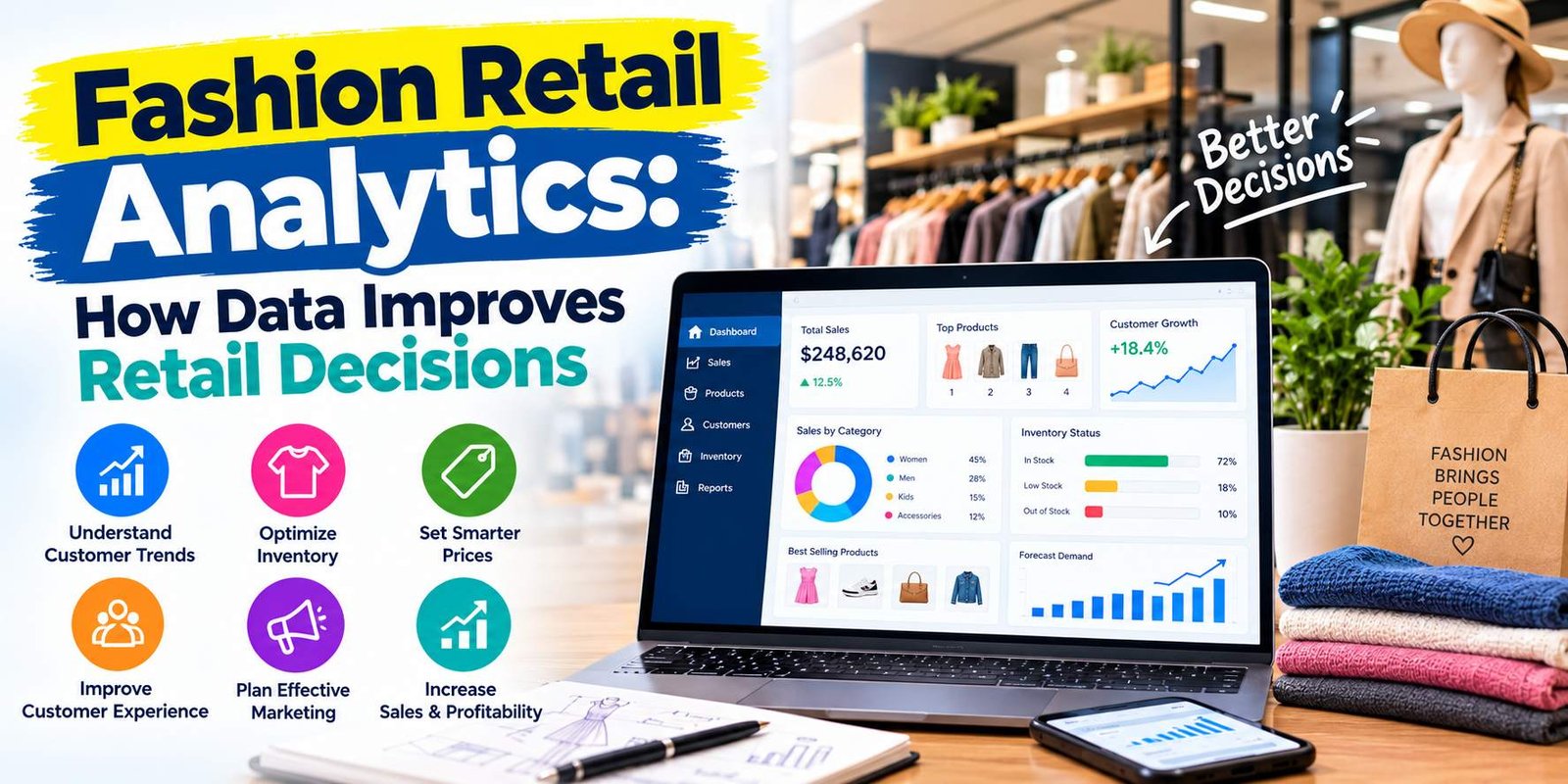
Fashion Retail Analytics: How Data Improves Retail Decisions
Fashion retail analytics helps clothing businesses understand what customers buy, why certain products perform well, and where sales opportunities may be getting lost. By studying sales records, inventory levels, customer behavior, and marketing results, retailers can make decisions based on real business activity instead of relying only on instinct.
A clothing store might notice that its new collection is attracting attention but generating fewer purchases than expected. Another retailer may discover that certain sizes sell out quickly while other items remain on the shelves for months. Fashion retail analytics helps explain these situations and gives businesses a clearer way to respond.
The process is useful for independent boutiques, online clothing stores, established fashion brands, and retailers selling through both physical and digital channels. The goal is not simply to collect more information. It is to turn useful data into practical decisions about products, prices, stock, customer service, and business growth.
What Fashion Retail Analytics Actually Tells You
Fashion retail analytics involves examining business data to understand patterns and improve decisions. The information may come from point-of-sale systems, online stores, inventory software, customer records, advertising platforms, and financial reports.
These sources reveal different parts of the business. Sales records show what people purchase, inventory data shows what remains available, and customer records can help explain repeat buying behavior. When these details are considered together, retailers can see a more complete picture of their operations.
Consider a boutique that sells dresses, denim, knitwear, and accessories. Its sales report might show that dresses generate the most revenue. However, a deeper review could reveal that denim produces a stronger profit margin, accessories are often purchased alongside dresses, and some dress styles require heavy discounts before selling.
Each finding suggests a different action. The owner might adjust future buying quantities, create coordinated product displays, or change the timing of promotions.
This is the practical value of analytics: it helps retailers move from noticing a result to understanding the factors behind it.
Why Fashion Retailers Need Better Data
Fashion businesses deal with changing customer tastes, seasonal demand, size variations, frequent product launches, and unpredictable trends. These factors make planning difficult, particularly when a retailer has limited cash available for inventory.
Data cannot eliminate uncertainty, but it can reduce avoidable mistakes.
Fashion Trends Do Not Always Translate Into Sales
A style can become popular on social media without generating enough purchases to justify a large inventory order. Customers may enjoy seeing a trend but prefer more affordable versions, different colors, or simpler designs when shopping.
Analytics allows retailers to compare online engagement with actual buying behavior. If a particular jacket receives many views but few orders, the business can investigate its price, fit information, product images, and customer feedback before ordering more stock.
Seasonal Products Have Limited Selling Windows
Coats, swimwear, holiday outfits, and occasionwear often have specific periods of stronger demand. Buying too much at the wrong time can leave a retailer with products that need substantial markdowns.
By comparing sales from similar seasons, retailers can estimate demand more carefully. These estimates should account for changes in pricing, weather, promotions, and product availability rather than assuming every season will repeat the previous one.
Customer Expectations Keep Changing
Shoppers may expect accurate size information, convenient checkout, fast communication, and clear return policies. Analytics can help retailers identify where their shopping experience falls short.
For example, a store might find that customers frequently add jeans to their carts but leave before paying. Reviewing shipping charges, checkout errors, delivery estimates, and product details may reveal issues that sales totals alone cannot explain.
The Main Types of Fashion Retail Analytics
Different forms of analysis answer different business questions. Retailers do not need to implement every type at once. They can start with the areas most closely connected to their current challenges.
1. Sales Analytics
Sales analytics examines revenue, units sold, average transaction value, product performance, and changes over time.
It can help answer questions such as:
- Which clothing categories generate the most revenue?
- Which products sell well at full price?
- Are sales increasing because of more orders or higher spending per order?
- Which locations or online channels contribute most to revenue?
A retailer can also compare sales by style, size, color, and price range. This level of detail is useful because strong overall sales may hide weak performance in individual product groups.
For example, a clothing brand may report growing revenue while its formalwear category declines. Breaking down the figures can help managers determine whether demand has shifted toward casual clothing or whether a particular collection needs attention.
2. Customer Analytics
Customer analytics examines purchasing habits, repeat visits, preferences, and responses to marketing.
It can help retailers understand which customers return regularly, which products are frequently purchased together, and how shopping behavior differs between customer groups.
A store might discover that some shoppers buy basic clothing throughout the year, while others make larger purchases during holiday seasons. The retailer can use these patterns to plan relevant campaigns rather than sending every customer the same message.
Customer analytics should respect privacy and use personal information responsibly. Retailers should collect only the information they need, explain relevant data practices, and follow applicable privacy laws.
3. Inventory Analytics
Inventory analytics focuses on stock levels, sell-through rates, replenishment needs, slow-moving products, and stockouts.
Fashion inventory is especially complex because each style may come in several sizes and colors. A retailer can have hundreds of units remaining while still being unable to meet demand for its most popular size.
Inventory analysis helps identify these gaps.
Suppose a store sells a particular pair of trousers quickly in sizes 6, 8, and 10, while larger sizes remain available. The right response may be to adjust the size mix in future orders rather than increase the total quantity of the product.
4. Marketing Analytics
Marketing analytics connects advertising activity with customer actions and sales outcomes.
Retailers can review website visits, email clicks, campaign costs, completed orders, and the revenue associated with particular campaigns. This can help them decide where to allocate future marketing budgets.
However, a click or social media interaction does not necessarily represent a sale. Businesses should distinguish between attention, website activity, completed purchases, and profit.
They should also be careful when attributing sales to a single campaign. A shopper might discover a brand through social media, search for it later, and complete the purchase after receiving an email.
5. Financial Analytics
Financial analytics examines the economic results behind retail activity. Relevant measures include gross profit margin, operating expenses, discount costs, return-related expenses, and profitability by product category.
A product that sells quickly may not be the most profitable item in a collection. If its margin is low and its return rate is high, it may contribute less to the business than expected.
Reviewing financial results alongside sales and inventory data helps retailers make decisions that support sustainable performance rather than revenue alone.
Fashion Retail Analytics Metrics Worth Tracking
The most useful metrics depend on the store’s size, sales channels, and goals. A small business can begin with a focused set of measures and expand its reporting as its needs become more complex.
| Metric | What it helps explain |
|---|---|
| Sales revenue | How much the business earns from product sales |
| Average order value | How much customers spend per order |
| Conversion rate | How effectively visitors become buyers |
| Inventory turnover | How frequently inventory is sold and replaced |
| Sell-through rate | How much available merchandise sells during a period |
| Gross profit margin | How much sales revenue remains after product costs |
| Customer retention rate | How well the business keeps existing customers |
| Return rate | How frequently purchased products are returned |
| Customer acquisition cost | How much it costs to acquire a new customer |
| Markdown rate | How much prices are reduced from their original levels |
These measures are most valuable when they are reviewed together.
For example, a rising conversion rate may appear positive, but if the increase comes from a deep discount that reduces profit, the overall result may be less attractive. Similarly, high inventory turnover may indicate efficient selling, but it could also point to stock levels that are too low to meet demand.
Retailers should define each metric clearly, calculate it consistently, and compare it across suitable time periods.
How Fashion Retail Analytics Improves Buying Decisions
Product buying is one of the areas where data can make a noticeable difference. Fashion retailers must decide which styles to order, how many units to purchase, which sizes to stock, and when to replenish products.
These decisions tie up money before the retailer knows exactly how customers will respond.
Study Previous Product Performance
Past sales can provide a starting point for future orders. Retailers can examine how similar products performed, which sizes sold first, and how much stock remained at the end of a selling period.
However, historical results should not be copied blindly. A new collection may have a different price, fit, material, or target customer. Retailers should use past data as evidence, not as a guarantee of future demand.
Combine Sales Data With Current Conditions
A more useful buying decision considers several factors at once:
- Previous sales of comparable products.
- Current stock levels and supplier lead times.
- Seasonal timing and expected customer demand.
- Planned promotions and price changes.
- Available cash and storage capacity.
Imagine a retailer planning to purchase lightweight sweaters for autumn. Last year’s records show strong demand, but the current collection costs more and the supplier has a longer delivery time. The retailer can use these differences to adjust the order quantity and timing.
Review Results After Each Collection
When a collection finishes its main selling period, compare actual results with the original plan. Look at full-price sales, markdowns, returns, and remaining stock.
This review helps identify which assumptions were accurate and which need adjustment for the next buying cycle.
Using Analytics to Understand Online Fashion Shoppers
Online fashion retailers can observe many stages of the shopping journey, from the first product view to the final order. These details help identify problems that may otherwise remain hidden.
Find Where Customers Leave
A shopper may browse a product, select a size, add it to a cart, and then leave without completing the order. Each stage offers a clue about the shopping experience.
If many shoppers leave after seeing shipping charges, delivery costs may be affecting purchase decisions. If customers leave while selecting a size, the size guide or fit information may need improvement.
These patterns do not prove the cause on their own. Retailers should check site performance, customer feedback, and other evidence before making changes.
Improve Product Pages
Product page analytics can show which items attract attention and which generate purchases. When a page receives traffic but few orders, the retailer can review its content and presentation.
Useful improvements may include:
- Clear photographs from different angles.
- Accurate measurements and fit guidance.
- Fabric details and care instructions.
- Straightforward delivery and return information.
- A simple mobile shopping experience.
The goal is to answer common customer questions before they become reasons to leave the page.
Understand Product Combinations
Purchase records can reveal which items customers often buy together. For instance, shoppers purchasing a blazer may also buy tailored trousers or a simple top.
Retailers can use this information to create coordinated product suggestions, outfit collections, or relevant bundles. Recommendations should remain useful and natural rather than overwhelming customers with unrelated products.
How Artificial Intelligence Supports Fashion Retail Analytics
Artificial intelligence can help retailers examine large amounts of data, recognize patterns, and create forecasts. Its usefulness depends on the quality of the information available and how the business applies the results.
Demand Forecasting
Forecasting tools can estimate likely product demand using historical sales, seasonal patterns, prices, promotions, and other relevant inputs.
A retailer might use these estimates to plan the stock required for a new collection. The forecast can inform the decision, but managers should also consider supplier limitations, unusual events, and changes in customer preferences.
Product Recommendations
Recommendation systems can use shopping behavior and product relationships to suggest relevant items. An online store might recommend a matching belt when a customer views a dress or suggest similar jeans in a different fit.
These tools can help shoppers discover suitable products, but inaccurate recommendations may frustrate them. Retailers should review whether recommendations are relevant and whether they lead to useful outcomes.
Automated Reporting
Some analytics platforms can summarize performance changes, highlight unusual sales patterns, or produce regular reports. This can reduce the time spent gathering information manually.
Still, automated findings need context. A sudden sales decline might result from a technical issue, an item going out of stock, or a planned pause in advertising. The system may identify the change without knowing its full explanation.
AI should support informed human decisions, not replace careful review.
Choosing Tools for Fashion Retail Analytics
The right tools depend on the complexity of the business. An independent boutique may need little more than accurate sales reports and a well-maintained spreadsheet. A large retailer with multiple stores and an online business may need connected inventory, customer, marketing, and financial reporting systems.
Start With Existing Business Systems
Before purchasing new software, review the information already available through your point-of-sale system, online store, accounting platform, and inventory records.
Check whether the data is complete, current, and consistent. A sophisticated dashboard cannot compensate for missing transactions or incorrect stock counts.
Look for Useful Integrations
As a business grows, separate systems can create reporting problems. One platform may record sales, another may track stock, and a third may manage customer communications.
Connected systems can make it easier to compare results across channels. Before choosing a tool, confirm which integrations it supports and whether the setup meets your reporting needs.
Consider Cost and Ease of Use
A tool should save enough time or support sufficiently useful decisions to justify its cost. Consider subscription fees, staff training, maintenance, data security, and the effort required to keep records accurate.
Avoid paying for advanced forecasting or customer segmentation features before the business has a clear use for them.
Common Challenges When Using Retail Data
Analytics can improve decision-making, but its results are only as reliable as the data and assumptions behind them.
Incomplete records: Missing sales, inaccurate stock counts, and inconsistent product names can distort reports.
Seasonal changes: Comparing a holiday period with a quieter month may produce misleading conclusions unless seasonal differences are considered.
Small sample sizes: A few purchases do not necessarily establish a reliable pattern. Retailers should avoid making major decisions based on limited evidence.
Overreliance on forecasts: Estimates can become inaccurate when prices, customer preferences, supply conditions, or marketing plans change.
Privacy concerns: Customer information should be handled securely and in line with applicable legal requirements.
Too many reports: Tracking every available number can distract teams from the questions that matter most. A small, well-chosen dashboard is often easier to act on.
Retailers should also document how important metrics are calculated. Consistent definitions make it easier to compare results over time and avoid decisions based on mismatched reports.
Building a Practical Fashion Retail Analytics Routine
A useful analytics process does not have to be complicated. Retailers can establish a simple routine that connects business goals with regular reviews.
Step 1: Identify one business problem. Decide whether the priority is excess stock, low conversion, weak margins, or declining repeat purchases.
Step 2: Choose the relevant measurements. Select a few metrics that directly relate to the problem rather than building a dashboard filled with unrelated figures.
Step 3: Record a starting point. Measure current performance so that future changes can be compared against a clear baseline.
Step 4: Investigate possible causes. Look for differences by product, size, sales channel, time period, or customer group. Avoid assuming that a correlation automatically explains the result.
Step 5: Test a practical change. Adjust product information, buying quantities, campaign timing, or another relevant factor.
Step 6: Review the outcome. Compare results after an appropriate period and consider whether other changes affected the outcome.
For example, if an online clothing store struggles to sell a particular dress, the owner might improve the fit description and add clearer product photographs. The owner can then monitor product-page conversion and customer questions to assess whether the changes helped.
This approach turns analytics into an ongoing business habit instead of a report that gets opened once and forgotten.
Frequently Asked Questions
What is fashion retail analytics used for?
Fashion retail analytics helps businesses understand sales patterns, inventory performance, customer behavior, marketing results, and profitability. Retailers use these insights to improve purchasing, pricing, merchandising, and the shopping experience.
Is fashion retail analytics useful for small clothing stores?
Yes. Small stores can begin with basic sales reports, inventory records, and spreadsheets. They do not need advanced software to identify their best-selling products, monitor slow-moving stock, or compare performance across seasons.
What is the difference between fashion retail analytics and fashion retail metrics?
Fashion retail metrics are individual measurements, such as conversion rate or inventory turnover. Fashion retail analytics is the broader process of examining those measurements, identifying patterns, and using the findings to make decisions.
Can analytics predict fashion trends?
Analytics can help identify changes in search activity, product demand, and customer buying behavior. These signals may support trend forecasting, but they cannot guarantee which styles will become popular or remain commercially successful.
How often should fashion retailers review analytics?
Daily reviews may be useful for stock availability and urgent sales issues. Weekly reviews can help assess campaigns and product performance, while monthly and seasonal reviews are useful for broader financial and buying decisions. The schedule should reflect the business’s needs.
Conclusion
Fashion retail analytics helps retailers understand the reasons behind their business results. By examining sales, customer activity, inventory, marketing, and financial performance together, clothing businesses can make more informed decisions about what to stock, how to price products, and where to improve the customer experience.
The most effective starting point is a clear business question and a small set of reliable measurements. Retailers can build from there as their data and reporting needs grow.
Used thoughtfully, fashion retail analytics can reduce guesswork, highlight new opportunities, and help fashion businesses respond more confidently to changing customer demand.




One Comment