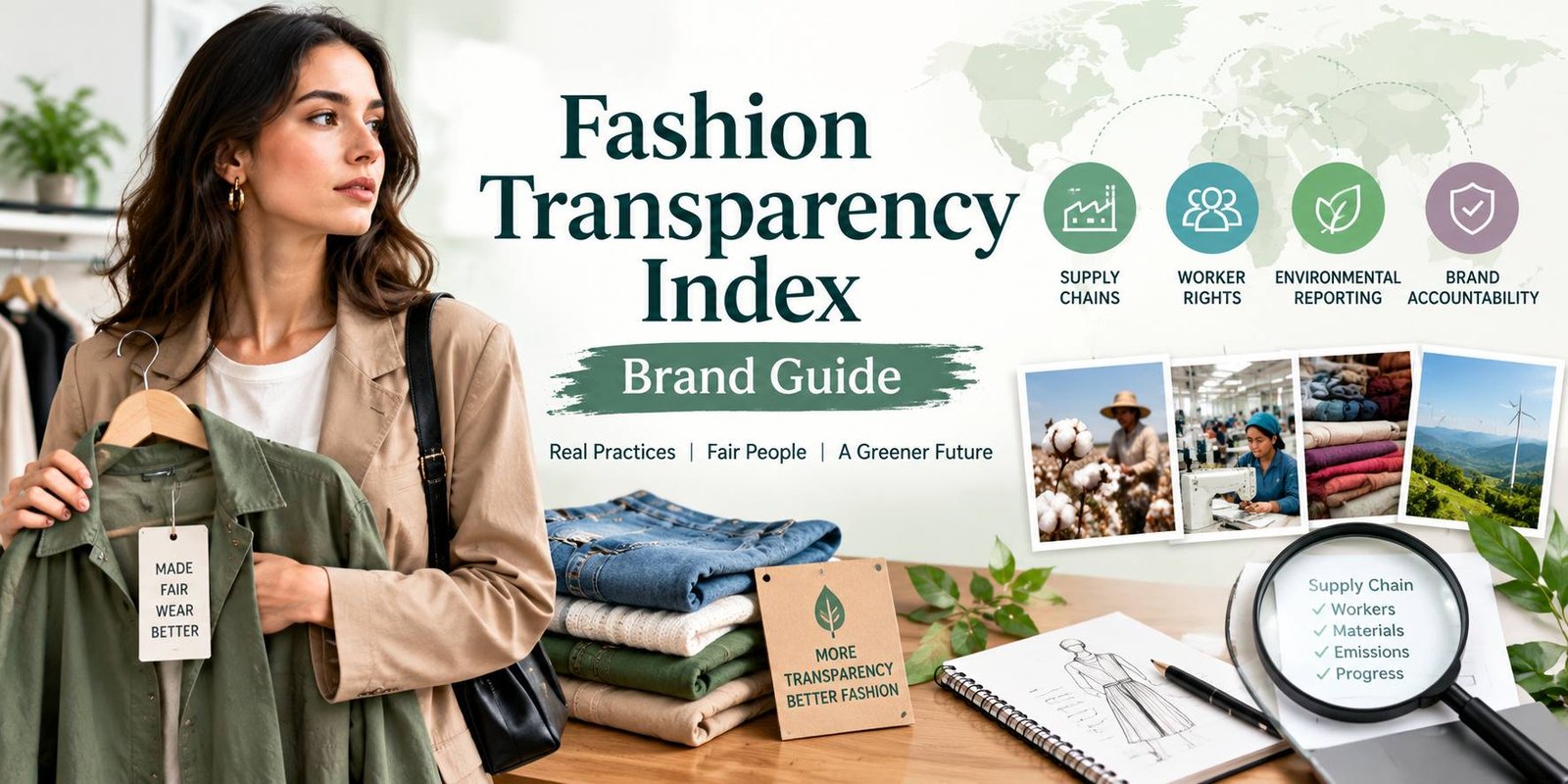
Fashion Transparency Index: Brand Guide
The Fashion Transparency Index helps bring attention to these questions.
Fashion companies operate through large networks of suppliers, factories, material producers, and service providers. Because of this structure, it can be difficult for an ordinary shopper to see what happens before a product reaches a store or website.
Transparency gives people a clearer starting point.
It encourages fashion businesses to publish useful information about their operations rather than relying only on attractive advertising. It also gives consumers, journalists, students, researchers, and campaign groups material they can examine.
However, transparency should be understood correctly. A company revealing more information does not automatically mean that its entire business is ethical or environmentally responsible. Instead, transparency makes it easier to see what a company says about its practices and where more questions may be needed.
What Does the Fashion Transparency Index Mean?
The Fashion Transparency Index is a research tool designed to examine the information fashion companies make publicly available.
One prominent index has been developed by Fashion Revolution. Its research has focused on the information brands publish about areas such as their supply chains, policies, workers, environmental activities, and governance.
The important idea is disclosure.
Imagine two companies selling similar jackets. One company simply says that its products are made responsibly. The other provides information about factories, policies, materials, worker programs, and environmental targets.
The second company has given the public more information to investigate.
That does not automatically make it the better company. It simply means there is more evidence available for people to examine.
Depending on the edition and methodology, transparency research can consider areas such as:
- Supplier disclosure
- Human rights policies
- Worker-related information
- Environmental reporting
- Purchasing practices
- Materials
- Climate commitments
- Governance
- Public accountability
The exact scoring system can change, so anyone using an index for serious research should consult the relevant edition and its methodology.
Why Fashion Transparency Deserves Attention
A fashion product can look simple while having a complicated background.
Consider a basic cotton sweatshirt. The cotton may be grown by one business. Another company may process the fiber. A separate facility can turn it into yarn, while another produces the fabric. Dyeing, cutting, sewing, packaging, and transportation can involve still more businesses.
The customer normally sees only the finished sweatshirt.
That distance between the shopper and the production process creates an information gap.
Transparency can reduce that gap.
When a brand publishes useful supply chain information, outsiders have a better chance of understanding where production occurs. They can also investigate policies, risks, and progress more effectively.
This matters because good fashion decisions require more than knowing whether an item looks attractive.
How Fashion Supply Chains Become Difficult to Follow
Fashion companies rarely operate through one single production site.
Instead, production may involve a network of direct suppliers and businesses working further down the chain. Some factories may also produce goods for several brands.
From Material to Finished Clothing
A simplified clothing journey can look like this:
Raw material → processing → yarn → fabric → dyeing → garment production → packaging → distribution → customer
Each stage can involve different organizations.
The more stages a product passes through, the harder it can become to track every detail.
Why Supplier Lists Matter
If a brand publishes information about its factories and suppliers, researchers have a better starting point for understanding production.
Supplier information can also help identify where additional questions should be asked.
For example, knowing the location of a factory can make it possible to examine local labor conditions, environmental concerns, or publicly available company information.
A supplier list does not prove that a factory is operating perfectly. Its value comes from making the production network more visible.
Fashion Transparency Index and Workers
Behind every garment are people performing different jobs.
Farm workers, factory employees, machinists, dyers, warehouse staff, drivers, and retail workers all contribute to the fashion system.
This makes worker-related disclosure an important part of transparency discussions.
A company may publish information about its approach to:
- Workplace safety
- Employee rights
- Working conditions
- Forced labor
- Child labor
- Discrimination
- Worker representation
- Complaints and grievance systems
- Responsible purchasing
These policies can show what a company expects from its operations and suppliers.
Yet there is an important difference between having a policy and proving that the policy works in practice.
A written commitment is only one piece of evidence. Actual implementation, monitoring, worker feedback, and corrective action provide additional context.
Environmental Disclosure in the Fashion Industry
Fashion also raises questions about natural resources and environmental impact.
Manufacturing can require energy and water. Certain production processes involve chemicals. Transportation creates additional impacts, while unwanted clothing can eventually become waste.
For this reason, environmental information is another useful part of transparency research.
Materials
Companies may disclose information about the fibers or materials they use.
This can include conventional fibers, recycled materials, regenerated fibers, or other material categories.
However, simply seeing a material described as “better” or “responsible” does not provide the whole picture.
The environmental story can depend on farming or extraction, processing, manufacturing, transportation, product lifespan, washing, and end-of-life treatment.
Climate Reporting
Some brands publish information about emissions and climate goals.
A useful report should provide more than an attractive environmental statement. Readers can look for measurable targets, reporting periods, progress updates, and explanations of what the company is actually measuring.
This makes it easier to distinguish detailed disclosure from general promotional language.
Transparency Does Not Mean Sustainability
This is one of the most important points to understand when discussing the Fashion Transparency Index.
Transparency asks: “What information is the company making available?”
Sustainability asks broader questions about environmental and social impact.
The two subjects overlap, but they are not interchangeable.
A company might openly report a difficult problem. That openness does not mean the problem has disappeared.
In fact, honest disclosure can sometimes reveal that a company still has significant work to do.
For example, a brand might publicly identify weaknesses in its supply chain and explain the steps it plans to take. The disclosure is useful even though the underlying problem remains.
This is why transparency should be viewed as a tool for visibility and accountability rather than a simple certificate of good behavior.
How Consumers Can Use Transparency Information
Most shoppers do not have the time or resources to investigate a fashion company from the ground up.
An index can make that process more manageable.
Instead of asking only, “Is this brand sustainable?” consumers can ask more specific questions.
Questions Worth Asking
Before buying from a brand, consider:
- Does the company identify its manufacturing locations?
- Does it explain its worker policies?
- Does it publish environmental information?
- Are its claims supported by specific details?
- Does it report progress over time?
- Does it explain where its materials come from?
- Is the information recent?
These questions encourage deeper thinking.
They also make it easier to separate meaningful information from broad marketing statements.
Do Not Treat a Score as a Shopping Verdict
A transparency score should not be treated as a universal ranking of fashion quality.
A company receiving more attention for disclosure may simply be more open about information. Another company might have useful practices but provide less public detail.
Therefore, an index result is best used as a research signal.
Look at the categories behind the result. Read the methodology. Check the date. Then decide what information matters most to you.
Fashion Transparency Index and Greenwashing
Greenwashing can occur when marketing gives consumers a stronger impression of environmental responsibility than the available evidence supports.
Fashion advertising sometimes uses attractive words such as “green,” “conscious,” “clean,” or “responsible.”
Those words may sound impressive, but they do not always explain what changed in the company’s production system.
Transparency encourages a different approach.
Instead of stopping at a claim, look for supporting information.
For example, a shopper could ask:
What material is being used?
Where was it produced?
What percentage of the product does the claim cover?
Does the company publish evidence?
Is there a measurable target?
Specific answers are more useful than slogans.
What Brands Gain From Better Disclosure
Transparency is not only valuable to shoppers.
Fashion businesses can also benefit from knowing their supply chains more clearly.
Better Risk Awareness
A company that understands its suppliers can identify potential weaknesses earlier.
These weaknesses might involve production delays, labor concerns, environmental risks, or dependence on a small number of facilities.
Better visibility can support stronger planning.
Stronger Communication
Customers increasingly ask questions about how clothing is produced.
Clear public information can help brands communicate with shoppers without depending entirely on advertising language.
It can also provide journalists and researchers with material that can be checked.
More Internal Discipline
Once a company publishes goals, policies, or supplier information, those commitments become easier for outsiders to monitor.
Public reporting can therefore encourage companies to keep records and review their own progress.
Problems That Make Fashion Transparency Difficult
Greater transparency sounds simple, but fashion production is rarely simple.
Suppliers Can Change
A factory may stop working with a brand. A company may move production. A supplier may use another business for part of its work.
This means published information can become outdated.
For that reason, current reporting matters.
Deeper Supply Chains Are Harder to Map
A brand may know its direct garment factory but have less visibility into the businesses supplying fabric, yarn, chemicals, or raw materials.
The further information moves away from the final product, the more difficult tracking can become.
Information May Be Incomplete
A company can publish a large amount of material without answering every important question.
Readers should therefore examine what is missing as well as what is present.
A long report is not automatically a complete report.
How to Read a Fashion Transparency Index Report
If you are using an index for an article, school project, or personal research, do not begin with the score alone.
First, Read the Methodology
The methodology explains what researchers looked for and how results were calculated.
Without reading this section, it is easy to misunderstand what a score represents.
Next, Examine the Categories
Look at individual areas instead of relying on one overall number.
A company may provide strong information in one category and much less in another.
This gives a more detailed picture.
Then, Check the Date
Fashion businesses change quickly.
A report from several years ago may not accurately describe the company’s current suppliers or policies.
Always identify the year or edition you are using.
Finally, Follow the Evidence
If a company claims to have a certain policy or target, look for the public document behind that statement.
Evidence makes research stronger.
Fashion Transparency Index for Students
The topic can make an interesting project for students interested in fashion, business, marketing, sustainability, or global supply chains.
Students could choose several fashion brands and investigate the same set of questions for each one.
For example:
| Research Area | Question |
|---|---|
| Suppliers | Does the company identify factories? |
| Workers | Does it explain labor policies? |
| Materials | Does it provide material information? |
| Environment | Does it publish environmental targets? |
| Reporting | Does it provide recent progress information? |
The goal should not be to declare one company perfect.
Instead, students can learn how public information differs between businesses and how evidence can be evaluated.
Transparency and Responsible Shopping
Responsible fashion does not require consumers to become supply chain experts.
Small changes in how people research products can make shopping more thoughtful.
Before buying something because it is trending, consider whether you genuinely need it.
Before trusting an environmental claim, look for supporting details.
Before sharing a social media statement about a brand, check its source.
Before replacing an older garment, consider whether it can be repaired, altered, or styled differently.
These habits shift attention away from constant consumption and toward informed choices.
Why Personal Research Still Matters
No single index can answer every question about a fashion company.
An index may focus on public disclosure, while another source may examine environmental performance, labor conditions, product durability, or financial information.
That is why consumers should avoid relying on one number.
A stronger research process combines several forms of evidence.
For example, a shopper interested in worker rights might examine supplier information and labor policies. Someone focused on environmental issues might investigate materials, emissions, water use, and waste.
The best approach depends on the question being asked.
The Future of Fashion Transparency
Fashion transparency is likely to remain important as supply chains become more closely examined.
Digital tools may make it easier for companies to collect and organize supplier information. New reporting systems could also make product-level information more accessible.
At the same time, consumers may continue asking brands to provide clearer evidence behind environmental and social claims.
Future transparency will therefore be about more than publishing a long document.
Useful disclosure should be:
- Easy to find
- Understandable
- Recent
- Specific
- Relevant
- Supported by evidence
The goal is not simply to produce more information. The goal is to produce information that people can actually use.
Frequently Asked Questions About the Fashion Transparency Index
What is the main purpose of the Fashion Transparency Index?
Its main purpose is to examine the amount and type of information fashion companies publicly disclose about selected areas of their operations.
Does the index prove that a fashion brand is ethical?
No. A transparency result should not be treated as proof that a company is completely ethical, sustainable, or responsible.
Why are fashion supply chains difficult to understand?
Fashion products can involve many businesses and production stages across different countries. A brand may therefore work with a large network rather than one factory.
Can the index help shoppers?
Yes. It can help shoppers identify what information a company makes available and encourage them to investigate brands more carefully.
Is transparency the same as sustainability?
No. Transparency concerns disclosure, while sustainability covers broader environmental and social questions.
Why should consumers check the year of a report?
Supplier relationships, policies, targets, and business practices can change. A newer edition may provide information that is more relevant to the current situation.
Conclusion
The Fashion Transparency Index gives people a useful way to think about the information fashion companies choose to reveal. Clothing may appear simple from the outside, but the journey behind a garment can involve many workers, suppliers, materials, factories, and countries.
Greater visibility can make that system easier to understand.
For consumers, transparency can lead to better questions. For students, it can provide a starting point for research. For brands, it can encourage stronger documentation and public accountability.
At the same time, transparency should never be mistaken for a guarantee that a company has solved every environmental or social problem.
The most useful approach is to look beyond the headline score, understand the methodology, examine the categories, check the date, and follow the evidence.
Fashion becomes easier to evaluate when people can see more of what happens behind the finished product.


One Comment