
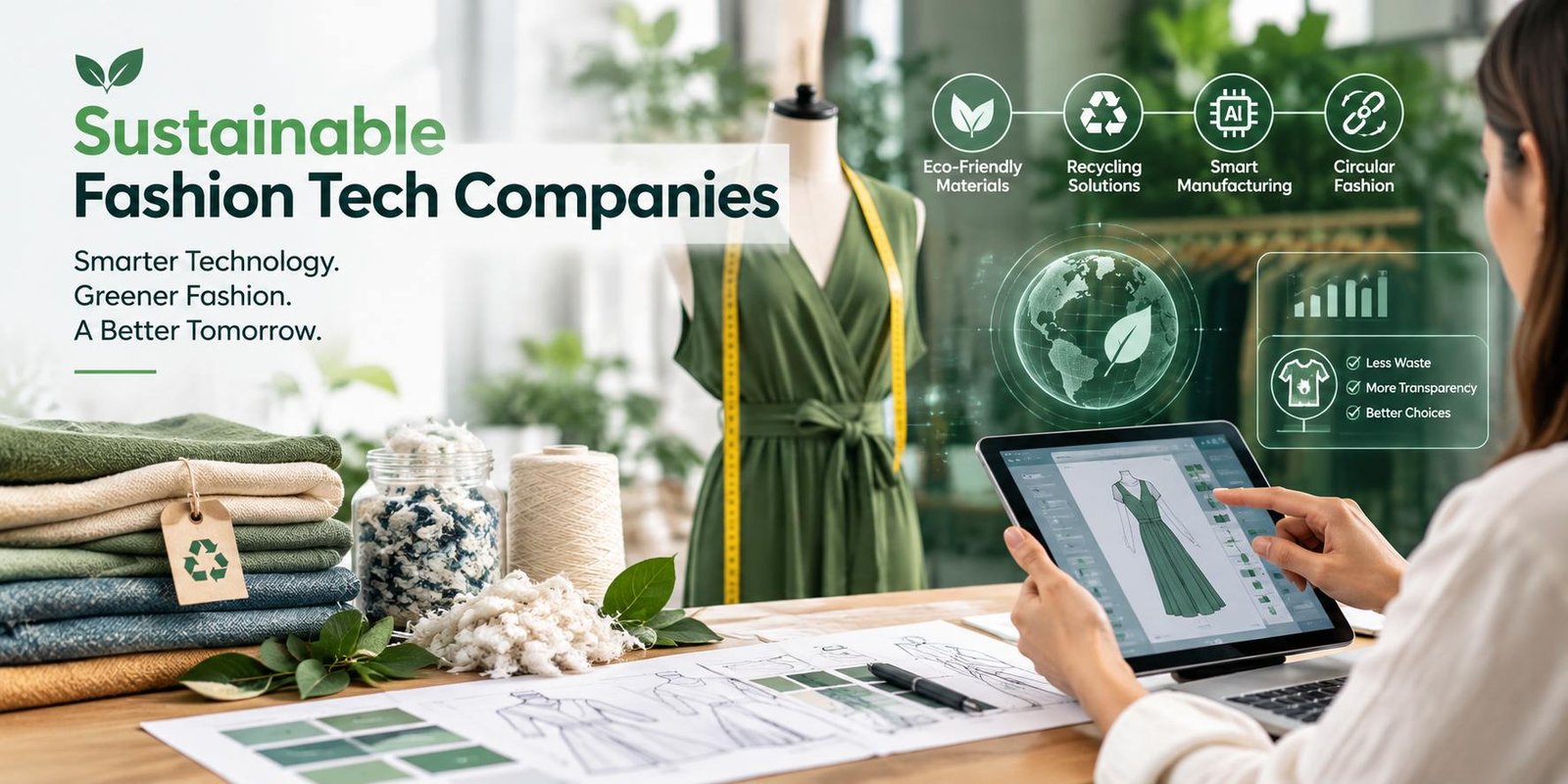
Sustainable Fashion Tech Companies: The Future of Fashion
Sustainable fashion tech companies are startups and businesses that use technology, such as recycling systems, new materials, software, and data tracking, to make clothing less wasteful and less harmful to the planet. Instead of asking shoppers to simply buy less, they try to change how clothes are made, tracked, reused, and recycled.
In this guide, you will meet the main types of sustainable fashion tech companies, see real examples from 2026, learn how to judge whether their claims are trustworthy, and find out how brands, investors, and job seekers can use this knowledge. The article is written in plain language, so you do not need a technical background.
What Are Sustainable Fashion Tech Companies?
These companies sit where fashion meets science and software. They usually focus on one stage of a garment’s life:
- Making it with cleaner materials and processes
- Tracking where it came from and how it was made
- Selling it with better fit, so fewer items are returned
- Reusing it through resale, repair, or rental
- Recycling it into new fiber when it can no longer be worn
Some are young startups, others are established firms that added sustainable technology to their business. What they share is a belief that fashion’s problems need practical tools, not just good intentions.
Why They Matter Now
Fashion produces huge volumes of clothing, and much of it ends up unused or discarded. Brands also face growing pressure from customers, investors, and regulators to prove their environmental claims. Technology helps by providing measurable data, scalable recycling, and traceable supply chains.
The sector is also attracting attention at an industry level. In September 2026, the European textile machinery committee CEMATEX selected 20 start-ups from nine countries for a grant to exhibit at ITMA 2027, covering areas from colorants and fibers to recycling, software, and testing. That shows innovation is spreading across the entire value chain, not just one corner of it.
The Main Types of Sustainable Fashion Tech Companies
1. Textile-to-Textile Recycling Companies
Most clothing waste is hard to recycle because fabrics are often blended and mixed with dyes or trims. Recycling companies develop ways to break old garments back into usable fiber.
- Syre: A textile company aiming to cut the industry’s emissions through textile-to-textile recycling. vcbacked
- Ambercycle: Focuses on textile recycling and building a closed-loop system for textile production. startupsavant
- Evrnu: Develops technology that breaks old garments down into high-quality fibers for reuse. causeartist
- Syntetica: Announced a $30 million raise in July 2026, with Lululemon among its backers, to address a major recycling problem in fashion. aifunding
What to watch: Scaling from a pilot plant to full commercial production is the hardest step. Even well-funded names in this area have faced financial trouble in the past, so look for real production volumes and brand partnerships.
2. Collection and Sorting Platforms
Recycling only works if used clothes can be collected, sorted, and sent to the right place.
- SuperCircle: Uses a digital platform that connects brands, recyclers, and sorters to make textile recycling more efficient and scalable. startupsavant
- Sortile: A textile waste management system that helps identify, trace, and recycle textiles. vcbacked
- For Days: A recycling and rewards platform designed to support circularity for textiles. vcbacked
3. Smart Design for Easier Recycling
Sometimes the fix starts at the design stage. Resortecs is one example, using dissolvable threads that make garments easier to take apart, which can reduce the time and cost of recycling. causeartist
4. New and Low-Impact Materials
These companies look for alternatives to conventional cotton, polyester, and leather.
- Fibe: Develops sustainable textiles by extracting fibers from potato harvest waste. vcbacked
- Circular Systems: Recycles food crop waste and textile waste into high-quality fibers for fashion and industrial use. causeartist
- Sapro-Tech: Provides leather alternatives made from fungi for products such as handbags. vcbacked
5. Cleaner Dyeing and Finishing
Dyeing and finishing use large amounts of water and chemicals. Newer approaches aim to reduce that burden.
- Vienna Textile Lab: Makes organic colors from naturally occurring bacteria. vcbacked
- Green Theme Technologies: Develops environmentally friendly dry textile finishing technology. vcbacked
- Ever Dye: Works on ecological dyeing processes for the textile industry.
6. Traceability and Transparency Platforms
Shoppers and regulators increasingly want to know where a garment came from.
- Fairly Made: Brings transparency and traceability to the global apparel supply chain.
Traceability tools help brands verify supplier claims, spot weak points, and share honest information with customers.
7. Smarter Manufacturing and Design Software
Technology can also cut waste before a single garment is sewn.
- Unspun: Creates 3D weaving technology for apparel.
- Topologic: Offers design and automation software for textile manufacturing.
- Rotostitch: Focuses on automated textile manufacturing technologies.
Digital sampling and automation can reduce prototypes, fabric offcuts, and overproduction.
8. Fit and Sizing Technology
Returns are costly for both money and the environment. SAIZ is one example of a platform that helps consumers and brands overcome fit and sizing challenges when shopping online. Better size matching can mean fewer packages traveling back and forth.
9. Resale and Preloved Platforms
Extending a garment’s life is often the most effective sustainability step. Online resale marketplaces, such as the example of It Closet, an online company for preloved fashion and clothing, make secondhand shopping easier and more trustworthy.
Quick Comparison Table
| Category | Main Goal | Example Companies |
|---|---|---|
| Textile recycling | Turn old clothes into new fiber | Syre, Ambercycle, Evrnu, Syntetica |
| Collection and sorting | Move used clothes to the right place | SuperCircle, Sortile, For Days |
| Design for recycling | Make garments easier to separate | Resortecs |
| New materials | Replace high-impact fibers and leather | Fibe, Circular Systems, Sapro-Tech |
| Cleaner dyeing | Cut water and chemical use | Vienna Textile Lab, Green Theme Technologies |
| Traceability | Prove where products come from | Fairly Made |
| Manufacturing software | Reduce sampling and production waste | Unspun, Topologic, Rotostitch |
| Fit technology | Reduce returns | SAIZ |
| Resale | Extend garment life | It Closet |
This list is for education, not an endorsement. Always check each company’s current status and claims.
How to Judge Sustainable Fashion Tech Companies
Not every green claim is reliable. Use this five-point check before trusting any company, whether you are a shopper, brand manager, or investor.
1. Is There Proof of Scale?
A lab result is not the same as a factory. Look for commercial production volumes, customer contracts, and operating facilities.
2. Are Claims Backed by Data?
Look for independent testing, certifications, or a published life-cycle assessment instead of vague phrases like “eco-friendly” or “planet-positive.”
3. Who Are the Partners and Backers?
Established brands, recognized investors, and research partners can signal credibility, though they are not a guarantee.
4. Does the Technology Solve the Real Problem?
A recycled fiber that still needs large amounts of virgin material, or a tool that only moves waste elsewhere, may not deliver the promised benefit.
5. Is the Company Transparent About Limits?
Honest companies explain what their technology can and cannot do, including the types of fabrics they can process.
How Brands Can Work With Sustainable Fashion Tech Companies
- Start with one pilot project, such as a recycled-fiber capsule or a traceability test on a single product line
- Set measurable goals, like reduced returns or lower material waste
- Ask for data sharing so results can be verified
- Train design and sourcing teams to use the new tools
- Communicate carefully, avoiding exaggerated marketing claims
Career Opportunities in the Sector
The growth of sustainable fashion tech companies is creating roles such as:
- Materials scientist or textile engineer
- Sustainability analyst
- Supply chain and traceability specialist
- Data analyst or software developer
- Product designer focused on circularity
- Partnerships and business development manager
People with both fashion knowledge and technical skills are especially valuable, because they can connect creative goals with practical solutions.
Challenges the Industry Still Faces
- Scaling costs: New plants and processes need heavy investment
- Blended fabrics: Mixed fibers remain difficult to recycle
- Collection systems: Used clothing must be gathered cleanly and consistently
- Greenwashing risk: Unsupported claims can damage trust for the whole sector
- Consumer behavior: Technology cannot fix overconsumption by itself
- Business risk: Some startups fail even when the idea is good
Understanding these limits helps keep expectations realistic.
What the Future May Hold
Several trends seem likely to grow: better textile sorting, more recycled fiber in everyday clothing, digital product records that tell a garment’s story, and tighter regulations that require proof of environmental claims. The most successful sustainable fashion tech companies will likely be those that combine strong science, sensible pricing, and honest communication.
Tips for Shoppers
- Prefer durable pieces and wear them often
- Try resale and rental before buying new
- Look for brands that publish clear sourcing and recycling information
- Be careful with vague green labels
- Return and repair clothes rather than throwing them away
Frequently Asked Questions
What are sustainable fashion tech companies?
They are businesses that use technology, such as recycling processes, new materials, software, or tracking systems, to reduce the environmental and social impact of clothing.
Which sustainable fashion tech companies are worth watching?
Examples include Syre and Ambercycle in recycling, SuperCircle in collection platforms, Fairly Made in traceability, and SAIZ in fit technology. Always research current details before making decisions.
Is textile recycling really possible at large scale?
It is progressing, but scaling remains difficult, especially for blended fabrics. Several companies and brand partnerships are working to move from pilots to commercial production.
How can I spot greenwashing?
Look for specific data, third-party certification, and clear explanations. Be cautious of broad claims with no numbers or proof.
Can small fashion brands work with these companies?
Yes. Many offer pilot programs, software subscriptions, or small-batch materials, though minimum orders can vary.
Do these companies make fashion cheaper or more expensive?
It depends. New materials may cost more at first, while tools that reduce returns and waste can lower costs over time.
Are sustainable fashion tech companies a good investment?
The sector has potential but also real risks, including high costs and uncertain demand. Anyone considering investment should do careful research and consult a qualified financial advisor.
How do I start a career with sustainable fashion tech companies?
Build skills in fashion, materials, data, or supply chains, follow industry events, and apply to startups, brands, or research organizations working in this area.
Conclusion
Sustainable fashion tech companies are showing that cleaner clothing is not only a matter of good intentions but also of better tools, from recycling plants and low-impact dyes to traceability software and smarter sizing. They still face big challenges, and not every promise will succeed. By checking proof, asking for data, and supporting transparent businesses, shoppers, brands, and investors can help the most useful ideas grow. Keep learning, stay curious, and treat technology as a partner in building a fashion industry that wastes less and lasts longer.




One Comment