
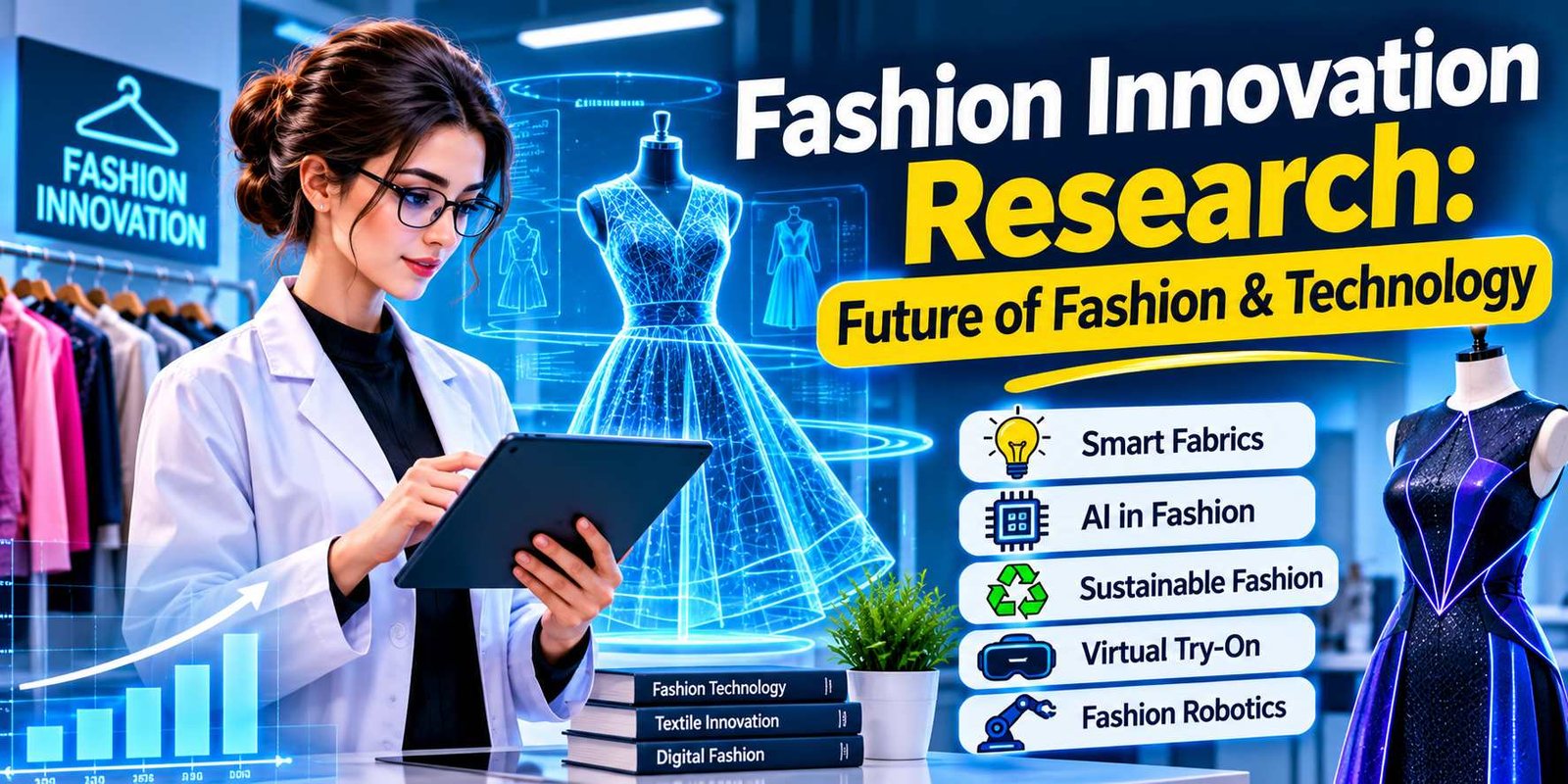
Fashion Innovation Research: Future of Fashion & Technology
Fashion is constantly changing. New fabrics, digital tools, production methods, shopping habits, and design ideas are changing how clothing is created and sold. Behind many of these changes is fashion innovation research, a field that helps designers, brands, researchers, and manufacturers understand new possibilities and turn creative ideas into practical solutions.
Fashion innovation research is not limited to designing unusual clothing. It can involve studying smart textiles, sustainable materials, artificial intelligence, digital fashion, 3D design, production technology, consumer behavior, and new business models. The goal is to discover better ways to create, produce, market, use, and reuse fashion products.
As customers become more interested in sustainability, personalization, comfort, technology, and transparency, fashion companies need better information before making important decisions. Research can help them identify opportunities while reducing waste, development costs, and unnecessary production.
This guide explains what fashion innovation research means, why it matters, the major areas being studied, and how research is helping shape the future of the fashion industry.
What Is Fashion Innovation Research?
Fashion innovation research is the study of new ideas, technologies, materials, processes, and consumer needs that can improve the fashion industry.
Traditional fashion research may focus on trends, historical clothing, consumer preferences, or market behavior. Innovation research goes a step further by asking what could be improved and what new solutions might be possible.
Researchers may investigate questions such as:
- Can a new material reduce the environmental impact of clothing?
- How can technology improve garment production?
- Can digital tools make fashion design faster?
- What do modern consumers expect from fashion brands?
- How can clothing become more durable?
- Can artificial intelligence support creative work?
- How can brands reduce textile waste?
- What role will digital clothing play in the future?
The answers can influence everything from early design concepts to manufacturing and retail.
Why Fashion Innovation Matters
Innovation is important because the fashion industry operates in a highly competitive environment. Customers have many choices, while brands must respond to changing preferences and new technologies.
Research gives companies a more reliable way to understand these changes.
Instead of simply following every new trend, a brand can study customer behavior, test products, examine materials, and evaluate new technologies before investing heavily.
Innovation can also improve the customer experience. Better sizing systems, personalized recommendations, virtual fitting tools, and improved fabric performance can make shopping and wearing clothing more convenient.
At the same time, innovation can support environmental goals. New production methods and alternative materials may help companies reduce waste, water use, energy consumption, or dependence on limited resources.
Major Areas of Fashion Innovation Research
Fashion innovation is a broad field. Researchers can explore many different areas depending on the problem they want to solve.
Sustainable Materials
One of the most important research areas is the development of more responsible materials.
Researchers are studying alternatives to traditional fibers and materials, including recycled fibers, plant-based materials, regenerated fibers, and innovative textile blends.
The purpose is not simply to create a material that sounds environmentally friendly. Researchers also need to consider durability, comfort, production requirements, cost, recyclability, and end-of-life options.
A material that performs well in one area may create challenges in another. Therefore, testing and comparison are important parts of the research process.
Smart Textiles
Smart textiles combine traditional fabrics with advanced functions.
Some smart textile research explores fabrics that can respond to temperature, movement, moisture, light, or other environmental conditions. Other projects investigate textiles that can work with electronic components or wearable technology.
Potential applications include sportswear, healthcare clothing, protective garments, and performance apparel.
Smart textiles show how the boundaries between fashion, engineering, and technology are becoming less clear.
Artificial Intelligence in Fashion
Artificial intelligence is becoming another major research area.
AI tools can analyze large amounts of information, identify patterns, support forecasting, assist with product recommendations, and help companies understand customer behavior.
Designers may also experiment with generative tools during the concept stage. However, AI does not remove the need for human creativity. Designers still need to decide whether an idea is practical, attractive, culturally appropriate, and suitable for a particular customer.
Research is therefore increasingly focused on how AI can support creative professionals rather than simply replace them.
3D Fashion Design
Three-dimensional design technology can change the way garments are developed.
Instead of creating every sample physically, designers can create digital versions of garments and examine shapes, proportions, colors, and details on screen.
This approach can reduce the number of physical samples needed during development.
It may also help teams work together across different locations. A digital garment can be shared with designers, manufacturers, buyers, and other professionals without requiring everyone to be in the same place.
Digital Fashion
Digital fashion is another growing research area.
Digital garments can exist primarily in virtual environments rather than as physical products. They may be used for gaming, social platforms, virtual events, digital identities, or creative experimentation.
Research in this area explores questions about ownership, identity, design, consumer demand, technology, and business models.
Although digital fashion does not replace physical clothing, it introduces another way for people to express personal style.
Consumer Research and Fashion Innovation
Technology alone does not guarantee successful innovation. Fashion products must still meet customer needs.
This is why consumer research is an important part of innovation.
Researchers may study:
- Shopping behavior
- Clothing preferences
- Price sensitivity
- Sustainability attitudes
- Brand loyalty
- Comfort expectations
- Online shopping habits
- Personalization preferences
- Social media influence
- Interest in new technologies
For example, a company may develop an advanced fabric with impressive technical features. However, if consumers find it uncomfortable or too expensive, the product may struggle in the market.
Understanding people is therefore just as important as understanding technology.
The Role of Sustainable Fashion Research
Sustainability has become a major subject within fashion innovation research.
The industry faces challenges involving resource consumption, textile waste, manufacturing processes, transportation, packaging, and garment disposal.
Researchers are exploring ways to improve different stages of the fashion lifecycle.
Better Material Choices
Alternative materials can potentially reduce dependence on conventional resources. However, researchers need to examine the complete lifecycle of a material rather than focusing on one feature.
Questions may include:
- How is the material produced?
- How long does it last?
- Can it be repaired?
- Can it be recycled?
- What happens when the garment is discarded?
- How much energy is needed during production?
This broader approach can provide a better understanding of sustainability.
Circular Fashion
Circular fashion focuses on keeping products and materials in use for longer.
Research may explore repair, resale, rental, recycling, remanufacturing, and product redesign.
Instead of thinking about clothing as something that is made, sold, worn, and thrown away, circular approaches consider how products can remain useful for longer periods.
This can create opportunities for both sustainability and new business models.
Textile Technology and Material Innovation
Textiles are at the center of fashion innovation.
A fabric can influence the comfort, appearance, durability, performance, and environmental impact of a garment.
Research teams may test textiles for strength, stretch, breathability, moisture management, insulation, color stability, and other characteristics.
New textile development can also support specialized markets.
For example, sportswear may require lightweight and breathable fabrics, while outdoor clothing may need weather resistance. Workwear may require durability, whereas luxury fashion may place greater emphasis on texture and appearance.
This means textile innovation is closely connected to the needs of different consumers.
Fashion Innovation and Wearable Technology
Wearable technology combines clothing or accessories with electronic functions.
Smartwatches are a familiar example, but research is also exploring technology integrated into garments.
Potential applications include fitness tracking, health monitoring, communication, safety, and performance measurement.
Fashion researchers must consider both technical performance and design.
A wearable product needs to function properly while remaining comfortable and visually appealing. If technology makes a garment heavy, uncomfortable, difficult to wash, or unattractive, consumers may not want to use it.
This makes collaboration between fashion designers, engineers, software developers, and researchers especially valuable.
How Data Supports Fashion Research
Data can help fashion companies make more informed decisions.
Brands can study sales information, search behavior, customer reviews, social media activity, website interactions, and other sources of information.
When analyzed carefully, this data can reveal patterns in consumer demand.
For example, researchers may discover that customers are increasingly interested in relaxed silhouettes, specific fabric types, certain colors, or particular price ranges.
However, data needs context. A sudden increase in interest does not always mean that a trend will become long-lasting.
Human judgment remains important when interpreting research findings.
Fashion Forecasting and Innovation
Fashion forecasting attempts to understand what customers may want in the future.
Traditional forecasting often examines cultural changes, runway collections, consumer behavior, retail activity, and social trends.
Modern research can add digital data and analytical tools to this process.
Researchers may compare information from multiple sources to identify emerging patterns.
The goal is not to predict the future perfectly. Instead, forecasting gives businesses a better basis for planning.
This can help brands decide which products to develop, which materials to explore, and which markets may offer opportunities.
Research Methods Used in Fashion Innovation
Different research questions require different methods.
Surveys
Surveys can collect information from many consumers. Researchers can ask people about shopping preferences, product expectations, sustainability, technology, and other topics.
Interviews
Interviews provide deeper information because participants can explain their opinions in their own words.
This can help researchers understand why customers make certain choices.
Focus Groups
Focus groups bring several participants together to discuss products, concepts, or ideas.
They can be useful during early product development.
Product Testing
Physical testing allows researchers to examine how a garment or material performs in real-world conditions.
Testing may evaluate durability, comfort, fit, washing performance, or other characteristics.
Market Analysis
Market research examines competitors, pricing, customer segments, industry developments, and commercial opportunities.
Experimental Research
Researchers can create controlled experiments to compare different materials, designs, technologies, or production methods.
Using more than one research method can provide a more complete picture.
The Importance of Collaboration
Fashion innovation rarely happens through one discipline alone.
A successful project may involve:
- Fashion designers
- Textile specialists
- Engineers
- Data analysts
- Software developers
- Marketing professionals
- Manufacturers
- Sustainability researchers
- Consumer researchers
Each professional brings a different perspective.
A designer may understand visual appeal, while an engineer may understand technical limitations. A sustainability specialist may identify environmental concerns, while a consumer researcher may explain customer expectations.
Collaboration can help turn an interesting idea into a practical product.
Fashion Innovation Research in Education
Universities and fashion schools can play an important role in innovation.
Students and researchers can experiment with materials, production methods, digital design, wearable technology, and sustainability.
Academic research can also explore problems that businesses may not have enough time or resources to investigate.
Fashion education is increasingly connected with technology and interdisciplinary study. Students may learn design alongside areas such as data analysis, materials science, digital modeling, sustainability, or product development.
This can prepare future professionals for a fashion industry that requires both creative and technical skills.
Challenges in Fashion Innovation
Innovation can create opportunities, but it also presents challenges.
High Development Costs
Research, testing, equipment, software, and specialist skills can require significant investment.
Smaller fashion businesses may find advanced research difficult to fund.
Technology Adoption
A new technology may work in a laboratory but become difficult or expensive to use at commercial scale.
Moving from an experiment to mass production can be a major challenge.
Consumer Acceptance
Customers do not automatically adopt every new product.
Some people prefer familiar materials, designs, and shopping experiences.
Sustainability Trade-Offs
A product can solve one environmental problem while creating another. Researchers therefore need to consider the entire lifecycle rather than relying on simple claims.
Data and Privacy
Fashion companies using customer data must handle information responsibly. Research should respect privacy and use appropriate data practices.
The Future of Fashion Innovation
The future of fashion innovation is likely to become increasingly connected to technology, sustainability, and personalization.
Artificial intelligence may support forecasting and product development. Digital design may reduce some physical sampling. Smart textiles may create new functions. Circular systems may encourage longer product lifecycles.
At the same time, consumers may continue to demand transparency and meaningful value from brands.
Future innovation will therefore not be only about creating something new. It will also be about creating something useful, responsible, durable, and relevant.
How Businesses Can Use Innovation Research
Fashion companies do not need to develop every new technology themselves.
They can begin with a clear problem.
For example, a company may want to reduce fabric waste. Researchers can then investigate better cutting techniques, digital sampling, material choices, or production planning.
Another brand may want to improve online shopping. It could research virtual fitting, size recommendations, personalization, or improved product information.
Starting with a real business or customer problem can make innovation research more focused.
A Practical Fashion Innovation Research Process
A structured process can make research easier to manage.
Step 1: Identify the Problem
Start with a specific question or challenge.
Step 2: Study Existing Knowledge
Review current research, technologies, products, and market developments.
Step 3: Develop Ideas
Generate several possible solutions instead of immediately choosing the first idea.
Step 4: Build a Prototype
Create a sample, digital model, material test, or other early version.
Step 5: Test the Concept
Evaluate performance, usability, appearance, cost, and customer response.
Step 6: Analyze Results
Compare the findings with the original goals.
Step 7: Improve the Solution
Make changes based on evidence and feedback.
Step 8: Consider Commercial Potential
Determine whether the innovation can realistically be produced, marketed, and supported.
This process helps transform research into practical innovation.
Why Original Research Matters in Fashion
Fashion changes quickly, so relying only on old information can limit innovation.
Original research allows brands and designers to discover new customer needs and identify opportunities before competitors.
It can also help companies make decisions based on evidence rather than assumptions.
For example, instead of assuming that customers want a certain sustainable fabric, a company can test consumer reactions and product performance.
This evidence-based approach can reduce risk and improve decision-making.
Fashion Innovation and the Consumer Experience
Innovation ultimately needs to create value for people.
A new garment may be technologically advanced, but customers still care about basic factors such as fit, comfort, appearance, price, durability, and ease of use.
The best innovations often combine advanced technology with familiar benefits.
A customer may not care about the technical process behind a fabric, but they may appreciate that the garment feels comfortable, lasts longer, dries quickly, or is easier to care for.
This is why successful innovation connects technical research with real human needs.
Final Thoughts on Fashion Innovation Research
Fashion innovation research is helping the fashion industry explore new materials, technologies, production methods, business models, and customer experiences.
Its importance goes beyond creating futuristic clothing. Research can help fashion businesses solve practical problems, improve products, reduce waste, understand customers, and prepare for future changes.
From smart textiles and artificial intelligence to circular fashion and digital design, innovation is creating new possibilities across the entire fashion system.
The most valuable innovations will likely be those that combine creativity with evidence. Fashion will continue to evolve, but research can help ensure that change is useful, responsible, and connected to the needs of real people.
For designers, brands, students, and researchers, fashion innovation research offers a way to explore what comes next while finding better solutions for the challenges the industry faces today.






One Comment