
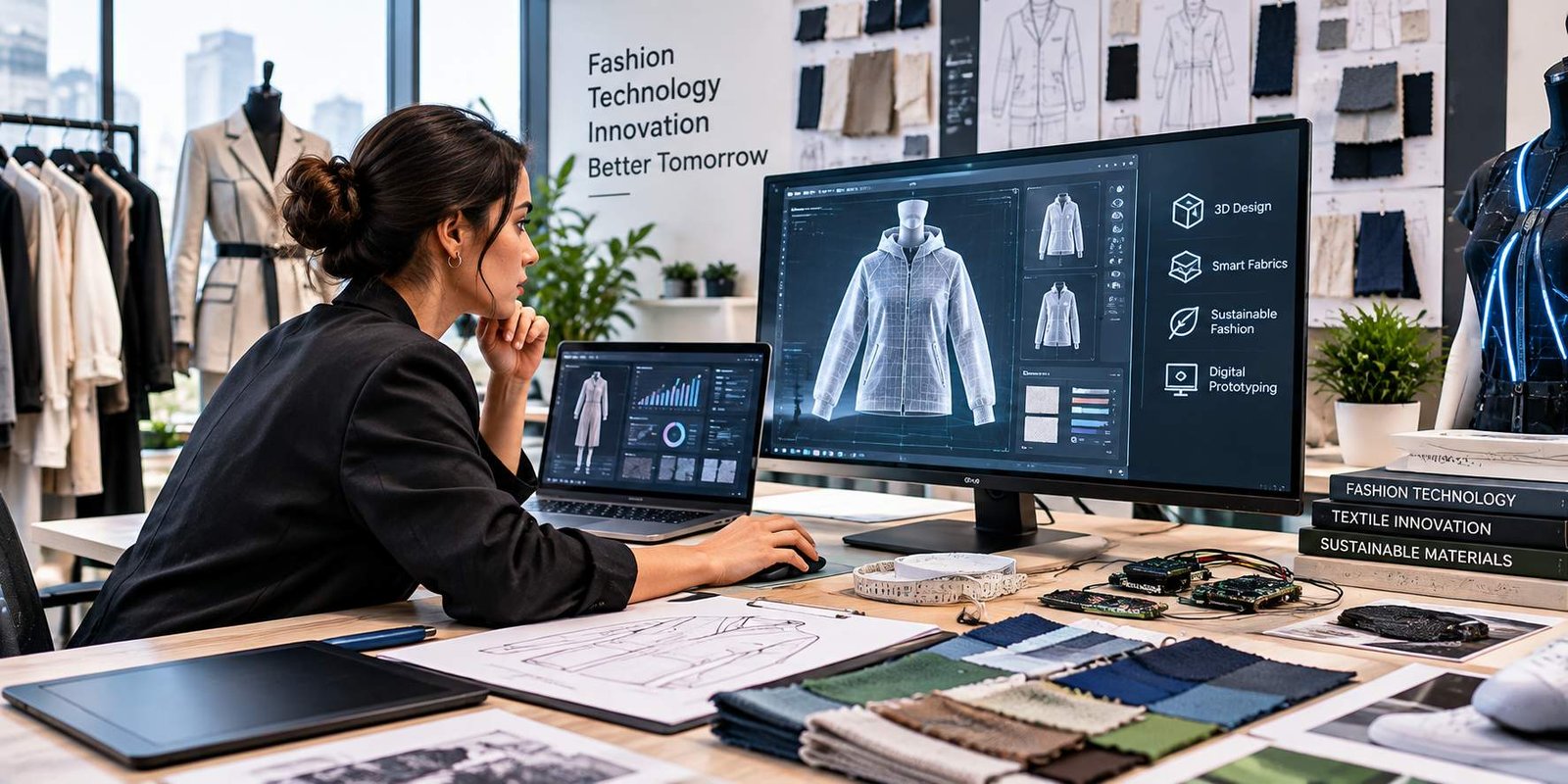
Fashion Technologist: Skills, Career & Future
A fashion technologist works where clothing, materials, manufacturing, design, and technology meet. The role can involve much more than using software to create digital garments. Depending on the job, a fashion technologist may test fabrics, improve production methods, work with 3D design tools, explore smart textiles, analyze technical garment data, or help a brand introduce new technology into its workflow.
This makes the career difficult to describe with one job title alone. One professional might spend most of the day in a product-development environment, while another could work with digital fashion software or wearable technology.
For anyone interested in fashion but also curious about engineering, computers, materials, or manufacturing, this field offers an unusual combination of creative and technical work.
What Is a Fashion Technologist?
A fashion technologist uses technical knowledge to improve the way fashion products are designed, developed, tested, produced, or experienced.
The job sits between creative ideas and practical execution.
A designer might sketch a jacket with an unusual construction. The technologist has to think about whether the proposed shape can actually be made, which materials would work, how the garment should be constructed, and what problems could appear during production.
In a technology-focused company, the work can look very different. A technologist might help create a 3D garment, evaluate a digital fitting system, or work on clothing that includes electronic components.
The common thread is problem-solving.
Instead of asking only, “Does this look good?” a fashion technologist may also ask:
- Can it be manufactured consistently?
- Will the material behave as expected?
- Can the design be represented accurately in digital form?
- How can production become more efficient?
- Is the technology useful to the person wearing the product?
- Can the idea work at a commercial scale?
That broader perspective makes the role valuable across different parts of the fashion industry.
Where a Fashion Technologist Fits Into Fashion
Fashion companies have many moving parts. Designers, buyers, merchandisers, pattern makers, manufacturers, marketers, and retailers may all work on the same product at different stages.
A technologist can act as a bridge between several of these groups.
For example, imagine a brand developing a lightweight rain jacket. The creative team may have a particular silhouette in mind. The materials team needs to identify a suitable fabric. The product-development team needs to determine construction details. The manufacturer needs clear technical information.
A technologist can help connect those decisions so the final product remains close to the original concept while still being practical to make.
That is one reason the profession cannot be reduced to a single task.
What Does a Fashion Technologist Do?
Daily responsibilities vary by employer, but several types of work appear frequently across the field.
Product Development and Testing
Some technologists work directly with garments and materials.
They may examine samples, review construction, test performance, document problems, and suggest changes before production moves forward.
Suppose a sportswear company develops a new training top. The first sample might look correct but feel restrictive around the shoulders. A technologist could investigate the pattern, fabric behavior, seam placement, and construction before recommending a modification.
The goal is not simply to identify something that is wrong. It is to understand why it happened and determine what should change.
Technical Garment Development
Technical work can include specifications for measurements, construction, materials, components, and production requirements.
Accuracy matters because small differences can affect the finished garment.
A technologist may work with technical drawings, measurement information, garment specifications, samples, and production documentation.
This side of the profession is especially important when a product moves from a design studio into manufacturing.
Digital Fashion and 3D Design
Digital tools have created another area of opportunity.
Three-dimensional fashion software can allow teams to create and examine garments digitally before producing physical samples. Depending on the workflow, a digital garment can be used to explore proportions, colors, materials, fit, and construction.
A fashion technologist may help designers understand what the software can realistically do, maintain digital product standards, or connect virtual development with physical manufacturing.
The advantage is not simply that a garment looks impressive on a computer screen. The real value comes when digital work improves decision-making.
Fashion Technology Requires More Than Creativity
People sometimes assume that working in fashion technology means choosing between artistic ability and technical knowledge.
In reality, both can matter.
A person may understand garment construction extremely well but struggle to communicate with a design team. Another person might be comfortable with advanced software but have little understanding of how fabric behaves.
Strong professionals learn to connect those worlds.
Communication becomes especially important when technical recommendations affect a creative concept. A technologist may need to explain why a particular material will not produce the intended result and then suggest another approach without losing sight of the designer’s original idea.
Skills Needed to Become a Fashion Technologist
There is no universal skill list because the profession includes several specializations. However, a useful foundation combines fashion knowledge with technical thinking.
Understanding of Materials
Fabric does not behave like a static picture.
It stretches, folds, shrinks, absorbs moisture, responds to heat, and changes depending on how it is constructed.
Understanding these characteristics helps technologists make better decisions about product development.
Someone working with performance clothing, for instance, may need to consider stretch and moisture management. A person working with tailored garments may pay more attention to structure, stability, and finishing.
Knowledge of Garment Construction
A strong understanding of how clothing is assembled can make technical problems easier to diagnose.
This includes familiarity with seams, patterns, components, finishing methods, fit, and production processes.
The more clearly a technologist understands the relationship between a pattern and the final garment, the easier it becomes to identify practical improvements.
Digital Skills
Technology-focused fashion roles can involve a range of software.
Depending on the position, useful areas may include:
- 2D pattern development
- 3D garment visualization
- Technical drawing
- Digital product development
- Product data management
- Computer-aided design
- Digital sampling
- Data analysis
The specific software matters less than the ability to learn and apply digital tools to real fashion problems.
Analytical Thinking
Technical fashion work often involves comparing options.
A company may need to choose between two materials, production methods, or development processes. The best decision may depend on cost, durability, appearance, manufacturability, performance, and customer expectations.
Analytical thinking helps a technologist balance these factors instead of focusing on one characteristic alone.
Education and Training
People enter fashion technology through different educational routes.
A fashion-related degree can provide knowledge of design, textiles, pattern development, production, or product development. Programs with a strong technical focus can be particularly useful for people interested in the practical side of fashion.
Other paths can include textile studies, product development, engineering-related education, computer-aided design, or specialized training in digital fashion tools.
Education is only part of the preparation.
Practical experience can be equally valuable because fashion technology involves applying knowledge to real products. Building projects, creating digital samples, studying materials, or documenting product-development decisions can help demonstrate practical ability.
A Practical Example of the Job
Consider a fictional footwear company developing a lightweight everyday sneaker.
The designers want a thin sole and a flexible upper. During early development, the product team discovers that the prototype does not provide enough support.
A fashion technologist could examine the material combination, construction, and digital specifications. They might suggest changing the internal structure while keeping the visible design almost unchanged.
The next prototype performs better.
This example illustrates an important part of technical fashion work: the best solution is not always a completely new design. Sometimes it is a small technical change that allows an existing creative idea to work.
The Role in Sustainable Fashion
Technology can also influence how fashion companies approach resource use.
A technologist may contribute to projects involving material efficiency, digital sampling, product durability, repair, recycling, or improved manufacturing processes.
Digital development can sometimes reduce the need for physical prototypes, although the exact environmental benefit depends on how a company uses the technology and what physical processes remain necessary.
Material selection also requires careful thinking. A fabric cannot be considered a better choice simply because it has a particular sustainability label. Its durability, production process, care requirements, end-of-life options, and intended use all matter.
This is where technical knowledge becomes useful. A technologist can evaluate a material as a real product component rather than viewing it only as a marketing feature.
Smart Clothing and Wearable Technology
One of the more experimental areas of the profession involves clothing with technological functions.
Smart garments may incorporate sensors, conductive materials, electronic components, or connections to digital systems.
The challenge is significant.
A piece of clothing must remain comfortable and wearable while the technology performs its intended function. Components cannot simply be added without considering weight, movement, washing, durability, safety, and appearance.
A fashion technologist working in this area may need to collaborate with people from electronics, software, materials science, and product engineering.
That interdisciplinary environment is one of the most interesting parts of the career.
Artificial Intelligence and the Changing Role
AI is also influencing fashion workflows.
It can assist with tasks such as image generation, trend analysis, product information, forecasting, and other forms of digital work. However, AI does not remove the need for technical fashion knowledge.
A generated design still has to make sense as a physical product.
A digital concept may use materials that cannot produce the shown shape. A virtual garment may look convincing but fail to account for construction details. A trend prediction may be interesting without being commercially useful.
The fashion technologist can help evaluate these gaps.
In that sense, technology may change the tools professionals use without eliminating the need for people who understand how fashion works in the real world.
Career Options for a Fashion Technologist
The profession can lead to several different types of positions.
Depending on experience and specialization, someone may work in:
Apparel Product Development
This path focuses on taking clothing from an initial concept toward a manufacturable product.
Digital Fashion
Professionals in this area may work with 3D garments, virtual samples, digital product assets, or online fashion experiences.
Textile Technology
This route can involve materials, performance fabrics, testing, finishing, and innovative textile development.
Manufacturing Technology
Some roles focus on improving production processes, technical systems, quality, or factory workflows.
Wearable Technology
Professionals can work on garments and accessories that combine fashion with electronics or connected technologies.
Fashion Software and Technology Companies
A technologist may also work for a technology company that develops tools for brands, retailers, manufacturers, or designers.
This option can be attractive for people who enjoy fashion but want to spend more time around software and product development.
How to Build a Strong Portfolio
A portfolio for this career does not need to look exactly like a traditional fashion-design portfolio.
It should demonstrate how you think.
A useful project could show a problem, the investigation, the technical choices, and the final result.
For example, instead of simply presenting a digital jacket, document:
- The original design idea.
- The material selected and why.
- The construction approach.
- A digital or physical prototype.
- Problems discovered during development.
- Changes made after testing.
- The final outcome.
This tells an employer much more about your ability than a collection of attractive images alone.
What Makes the Career Different From a Fashion Designer?
The two roles can overlap, but their priorities are often different.
A fashion designer typically concentrates heavily on visual direction, concept, silhouette, styling, and creative expression.
A technologist is more likely to focus on how the idea functions, how it can be developed, what materials and processes are appropriate, and how technology can improve the outcome.
Neither role is more important than the other.
A successful product often needs both creative direction and technical execution.
In smaller companies, one person may even perform parts of both roles.
Challenges in the Profession
Fashion technology is exciting, but it is not always easy.
Technology changes quickly, which means professionals need to keep learning. Software updates, new production systems, emerging materials, and changing consumer expectations can all affect the job.
There is also a practical challenge: fashion is physical.
A digital tool can help with development, but clothing still has to fit a body, survive use, meet production requirements, and satisfy the customer.
Professionals who understand both digital systems and physical products can therefore bring a particularly useful perspective.
The Future of the Fashion Technologist
The role is likely to continue expanding as fashion companies adopt more digital tools.
Future work may involve stronger connections between 3D product development, artificial intelligence, manufacturing data, virtual retail, advanced materials, and connected products.
However, the profession will not be defined only by new gadgets.
The most valuable technologists will likely be people who can look at a real business or product problem and decide when technology is actually the right answer.
That judgment is important. Adding software to a broken process does not automatically fix the process.
A thoughtful technologist asks what needs to improve first and then selects the appropriate tool.
Final Thoughts
A fashion technologist brings technical thinking into an industry traditionally associated with creativity and visual design. The career can involve garments, textiles, software, digital development, manufacturing, sustainability, or wearable technology.
What makes the field distinctive is the connection between ideas and execution. A designer may imagine something new, but technical knowledge helps determine how that idea can become a working product.
For people interested in fashion who also enjoy technology, materials, problem-solving, and experimentation, this career offers several directions to explore. The exact job may change from one company to another, but the central skill remains useful: understanding a fashion problem and finding a practical way to solve it.
SEO Title: Fashion Technologist: Skills, Career & Future
Meta Description: Learn what a fashion technologist does, the skills needed, career options, digital fashion tools, smart textiles, and the future of fashion technology.
Slug: fashion-technologist
Focus Keyphrase: Fashion Technologist
Category: Fashion Technology
Suggested Featured Image Concept: A modern fashion technology studio showing a fashion technologist working on a digital 3D garment displayed on a large monitor, surrounded by fabric samples, technical sketches, pattern pieces, a laptop, and smart textile components. The scene should combine fashion design with advanced technology in a clean professional editorial style, sized 1200 × 600 px.





One Comment